

The Man at Saryu Ghat How Arjun Sharma Turned Fifty in Ayodhya — and Met Someone Who Had Already Done What He Was Afraid To Arjun Sharma had spent his career managing things. Teams. Budgets. Timelines. Client expectations. His own ambitions. For twenty-eight years in a mid-sized manufacturing firm in Noida, he had been reliably, …

The Man at Saryu Ghat
How Arjun Sharma Turned Fifty in Ayodhya — and Met Someone Who Had Already Done What He Was Afraid To
Arjun Sharma had spent his career managing things.
Teams. Budgets. Timelines. Client expectations. His own ambitions. For twenty-eight years in a mid-sized manufacturing firm in Noida, he had been reliably, consistently, impressively useful. Senior Manager. Then VP Operations. A man who solved problems before they became problems.
Then he turned fifty.
And for the first time in his professional life, he had a problem he could not manage: he did not know what came next.
His children were independent. His home loan was paid. His performance reviews were still excellent. But at 11 PM one Tuesday — staring at a quarterly report he had already read three times — a thought surfaced that he had been pushing down for months:
Is this all there is?
His wife, Meera, had one suggestion. “Go to Ayodhya. Go alone. Walk around. Ram didn’t run from his questions — he walked toward them.”
So Arjun booked a train.
Ayodhya — First Morning
The city surprised him.
He had expected the old Ayodhya — dusty lanes, small mandirs, sleepy ghats. What he found was that and more — the grand Ram Mandir rising like a golden declaration, the Saryu river steady and unhurried, priests beginning their routines at 4 AM, and everywhere the quiet confidence of a city that has been sure of its identity for five thousand years.
Arjun did what the city invited him to do: he slowed down.
He did the parikrama. He sat in the Ram Mandir for longer than he planned. He ate from a leaf plate at a dharamshala kitchen — simple dal and rice, and it tasted better than anything he’d had at a client dinner in years.
By evening, he had no plan. He walked to Saryu Ghat.
The Man with the Notebook
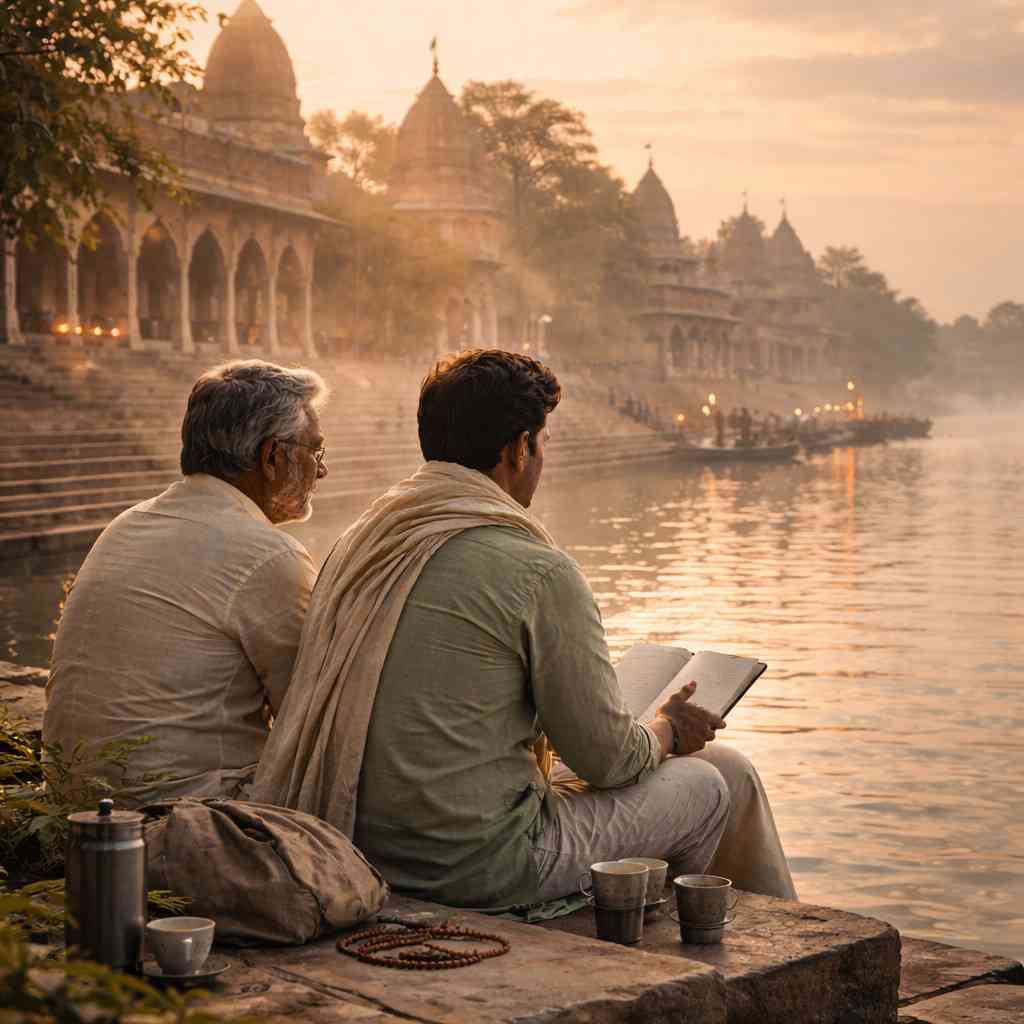
The ghat at dusk was a different world. Priests were performing the evening aarti. Diyas were being released on the water — little flames drifting downstream like quiet prayers. Families sat on the steps. Pilgrims chanted softly.
And on one of the upper steps, slightly apart from the crowd, sat a man with a small notebook, a pen behind his ear, and the unhurried posture of someone who had nowhere better to be.
He was around fifty himself — maybe a year or two older. Neat, trimmed beard. Simple cotton shirt. No phone in his hand, which Arjun found almost startling.
Arjun sat down nearby, drawn by the view. After a few minutes, the man looked up and nodded — the nod of two strangers who understand, without speaking, that they are watching the same thing for different reasons.
“First time in Ayodhya?” the man asked.
“Yes. You?”
“I’ve been coming for three years,” he said. “Now I mostly stay.”
A pause. A diya floated past.
“I’m Arjun. Arjun Sharma.”
“Sudhir. Sudhir Janakraj.”
What Sudhir Had Left Behind
Over the next hour, in the easy way that rivers and dusk encourage, Arjun learned who Sudhir Janakraj was.
He had been a management consultant — strategy and restructuring, mostly for mid-size corporates. Eighteen years. Good billing rates. Frequent flyer status on three airlines. Two investment properties. A reputation built carefully, credential by credential.
“Sounds like a full life,” Arjun said.
“It was a full calendar,” Sudhir said, without bitterness. “That’s different.”
At forty-eight, Sudhir had begun feeling what he called “the gap” — the space between how busy he was and how alive he felt. It widened slowly, then suddenly. He began questioning — not his career choices, not his marriage, not his relationships — but something more fundamental: what is this whole thing actually for?
“I started reading,” Sudhir said. “Not business books. The Gita. The Ramayana. The Upanishads. At first just out of curiosity. Then it became something else.” He looked at the river. “The answers were all there. They’ve always been there. I just needed to be quiet enough to hear them.”
He began visiting Ayodhya on weekends. Then longer. Then his consulting practice became one client, then phone calls, then occasional advice. His identity shifted — not dramatically, not with an announcement — but surely. From consultant who sometimes reflects to seeker who occasionally consults.
“Do you miss it?” Arjun asked. “The work, the status, all of it?”
Sudhir considered this honestly. “I miss feeling useful. But I found other ways to be useful. Quieter ways. Ways that don’t require a slide deck.”
“I’m Fifty,” Arjun Said. “Tell Me What The Scriptures Say.”
It came out directly — the way it does when a man finally admits he has been carrying a question for a long time.
Sudhir smiled. Not the smile of someone who has all the answers, but of someone who has sat with the same questions long enough to be comfortable with them.
“Let me tell you what I’ve learned,” he said. “In plain language. No jargon. No philosophy lecture. Just what the shastras actually say to a person exactly where you are right now.”
He opened his notebook — not to read from it, but the way a person touches something familiar when they’re about to say something important.
The Saryu flowed. The aarti bells faded. Two men sat on ancient steps, and one of them began to speak.
Ten Things the Scriptures Say — When You Turn Fifty
As Sudhir Janakraj explained them, at Saryu Ghat, Ayodhya
1. Recognize the phase you have entered
“The first thing the Manu Smriti tells us is simply this: know where you are. Life has four stages — Brahmacharya, Grihastha, Vanaprastha, Sannyasa. You spent your twenties learning. Your thirties and forties building — career, family, wealth, reputation. That was Grihastha, and you played it well.
Now you are at the door of Vanaprastha. The word means ‘turning toward the forest.’ Not that you must literally go anywhere. But your direction must change — from outward to inward. From acquiring to understanding. The corporate world will tell you fifty is just another decade. The shastras say it is a fundamentally different chapter. Treat it that way.”
2. Stop measuring your life in outputs
“The Bhagavad Gita, Chapter Three — Krishna tells Arjuna: do your work, but let go of the results. Nishkama Karma. For twenty-eight years, your value was measured in outputs — revenue, headcount, efficiency ratios. That framework served you. But it will quietly destroy your second half if you keep using it.
After fifty, the scripture says, shift your measure from what you produce to how you live. From results to quality of presence. You will feel this as loss at first — like the KPIs have been taken away. They have. That is the point.”
3. Give more than you take — especially knowledge
“The Mahabharata’s Anushasana Parva says knowledge given freely is the highest form of giving — higher than money, higher than food. Jnana daan is the greatest daan.
You have twenty-eight years of experience in how organizations work, how people work, how problems get solved. That is not nothing. That is irreplaceable. The scripture says your job now is not to hoard it or monetize it — but to give it away. Mentor someone. Teach something. Share without billing. The impact of that will outlast any quarterly result you ever produced.”
4. Simplify your life — deliberately
“Ram chose fourteen years in the forest over a palace. Not because he was forced to — he went with dignity, willingly. The Valmiki Ramayana shows this as the defining act of a great man: choosing simplicity when complexity was available.
For you, this is practical. Reduce subscriptions, commitments, obligations that drain without meaning. Simplify your finances — not to become poor, but to become free. Every unnecessary complexity is a tax on your attention. After fifty, your attention is your most valuable asset. Spend it like it is.”
5. Develop a daily practice — non-negotiable
“The Taittiriya Upanishad says: Svadhyayan ma pramadah — never neglect your daily inner work. Every dharmic tradition — the Gita, the Yoga Sutras, the Ramayana — assumes that a person in Vanaprastha has a daily sadhana. A practice. Not a hobby. A non-negotiable.
It doesn’t have to be long. Twenty minutes of stillness in the morning — meditation, prayer, chanting, reading, whatever your nature accepts. But it must be daily. A corporate person understands this instinctively: the fundamentals that made you successful — discipline, consistency, showing up — apply equally to inner life. The only difference is the metric.”
6. Fix your relationship with your body — now, not later
“The Charaka Samhita — Ayurveda’s foundational text — says that after fifty, the body begins a slow shift from pitta dominance to vata. Energy becomes more variable. Recovery slows. The body requires more respect, less punishment.
The scripture’s prescription is practical: eat simply, sleep adequately, walk daily, fast occasionally, reduce stimulants. No crash diets, no extreme programs. Just steady, respectful care. You maintained your car and your office infrastructure for years. Apply the same logic here. This is not vanity — it is stewardship of the vehicle you have been given.”
7. Release control of your children — fully
“This one is hard for high-achievers,” Sudhir said with a slight smile. “The Shantiparva of the Mahabharata is explicit: Vanaprastha means transferring household responsibility to the next generation. Not advising them constantly. Not managing from a distance. Transferring.
Your children are adults. Your job was to raise them — that job is done. The scripture says continuing to manage their lives is not love, it is attachment. And attachment, the Gita says, is the root of suffering — yours and theirs. Let go. Completely. Watch what opens up in you when you do.”
8. Find one thing that has no ROI — and do it seriously
“The Bhagavata Purana describes Krishna’s time in Vrindavan as lila — divine play. Not productive activity. Not strategic action. Pure, present, joyful engagement with no agenda.
The corporate mind finds this almost physically uncomfortable. We have been trained to justify everything by its return. The scripture says: the inability to do something purely for its own sake is a form of poverty. Learn music. Study a language. Tend a garden. Write. Paint. Walk without a destination. Not as self-improvement. As play. This is not wasted time — the Bhagavata says it is the closest a human being gets to the divine.”
9. Choose your company carefully — it will define your decade
“Satsanga — good company, company of truth-seekers — is mentioned in nearly every major scripture as the single most powerful force in a person’s spiritual and mental life. The Bhagavata Purana says: sa eva sadhu-sangena taraty avam svayam tatha — by the company of seekers, one crosses the ocean of confusion and helps others cross too.
After fifty, you have permission to be selective. Reduce time with people who drain, complain, or keep you locked in the past version of yourself. Seek people who are also questioning, also growing, also honest. Even one such friendship — like this one, here, tonight — can redirect a decade.”
10. Begin to think about death — not morbidly, but clearly
“The Katha Upanishad is a conversation with Yama, the god of death. A young man named Nachiketa asks him: what is the truth of existence? And from that single honest question — the willingness to face mortality — comes all of wisdom.
The scripture does not say to fear death. It says to use it as a lens. Ask yourself: if I had five years, not fifty — would I spend this week differently? Would I hold this grudge? Would I stay in this obligation? Would I keep postponing this conversation?
You don’t need the answer immediately. You just need the question alive in you. That question, kept honestly, will make every remaining year of your life more deliberately, beautifully lived than all the decades before.”
After the Diyas
By the time Sudhir finished, the ghat was quieter. Most pilgrims had left. The last diyas had floated out of sight. The Saryu moved on — steady, indifferent to schedules, sure of where it was going.
Arjun sat in silence for a long time.
“How did you know all this?” he finally asked.
“I didn’t,” Sudhir said. “I learned it slowly. Some of it from books. Some of it from sitting here long enough that the city started teaching me. Ayodhya does that — it has been in the business of dharma for five thousand years. It knows things.”
“Do you ever miss your old life? Honestly?”
Sudhir paused. “I miss the feeling of being certain. Of having a clear role and a clear scorecard. That certainty was comforting.” He looked at the river. “But certainty and peace are different things. I had certainty for eighteen years. I have been practicing peace for three. Peace wins. There’s no comparison.”
Arjun nodded slowly. Something was settling in him — not a decision exactly, but a direction. The way a compass needle settles: with small trembles first, then still.
He looked at the Saryu. The river had no plan. It had a nature, and it followed it completely. It did not argue with its banks or mourn the path it had already traveled. It simply moved — present, purposeful, unhurried.
I want to live like that, Arjun thought. For the second half.
Six Months Later
Arjun Sharma did not quit his job.
He did something harder — he changed his relationship with it. He moved from VP Operations to a mentoring role he designed himself. He stopped attending meetings that had no reason for his presence. He began waking at 5 AM — not to check email but to sit in silence for twenty minutes, something he had not done since childhood.
He read the Gita for the first time. Then the Ramayana. Slowly, one chapter at a time, the way you eat a meal you actually want to taste.
He stopped advising his son on his career. His son, noticing this, started calling him more.
He started teaching — voluntarily, without charge — at a small management institute near his home. Two hours on Saturday mornings. Operations strategy, practical decision-making, lessons from twenty-eight years in the field. The students were twenty-two and eager. Arjun found it the most satisfying work he had done in years.
He returned to Ayodhya every two months. He always looked for Sudhir at Saryu Ghat.
Sometimes Sudhir was there. Sometimes not. But the ghat was always there — and the river, and the diyas, and the question that Arjun now carried not as a burden but as a compass:
Am I living the second half — or just extending the first?
“Dharmam chara.” Simply: live rightly. — Taittiriya Upanishad
To every Arjun who has managed everything successfully and is now wondering what to do with the rest — the shastras have been waiting for your question. They have an answer. And it begins, always, with the courage to sit still long enough to hear it. 🙏











Comments
Sumit
It’s awesome to read.