The Sadhu of Vrindavan And the Man Who Had Already Arrived It was the second morning of Arjun Sharma's Vrindavan visit. The first day had humbled him — the parikrama, the crowds, the old sadhu by the Yamuna who had quietly dismantled twenty-seven years of his certainty in two hours. Arjun had slept deeply that …

The Sadhu of Vrindavan
And the Man Who Had Already Arrived
It was the second morning of Arjun Sharma’s Vrindavan visit.
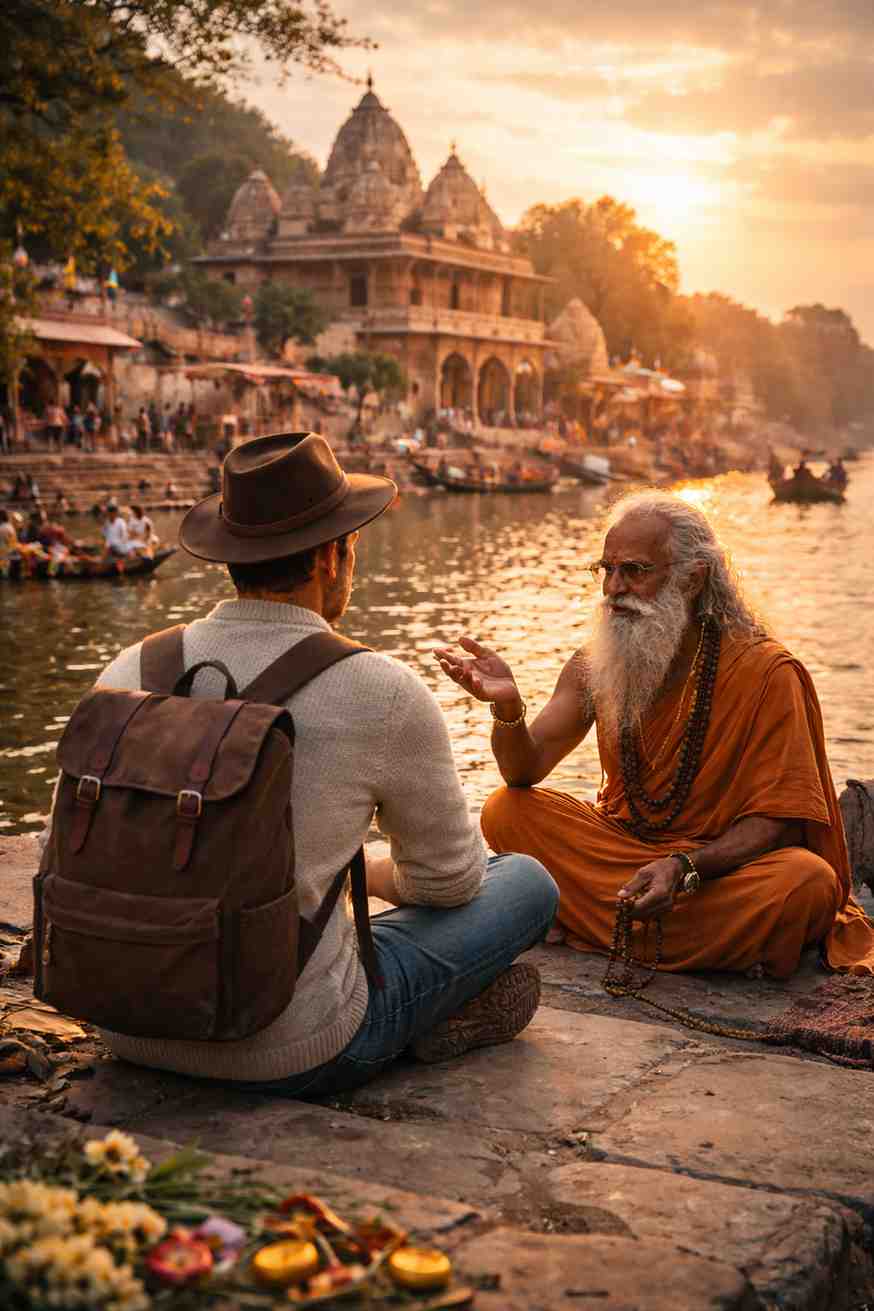
The first day had humbled him — the parikrama, the crowds, the old sadhu by the Yamuna who had quietly dismantled twenty-seven years of his certainty in two hours. Arjun had slept deeply that night, more deeply than he had in years, in a small dharamshala room that smelled of marigolds and old stone.
He woke before sunrise — unusual for him — and walked back to the ghat.
He wasn’t sure why. The sadhu might not even be there. But his feet remembered the way.
The Man on the Steps
The Yamuna at 5 AM was a different creature entirely. Mist sat on the water like a held breath. The ghats were quiet except for the sound of a single conch somewhere upstream and the soft lapping of the river against the stone steps.
Arjun descended toward the water and noticed a man sitting three steps above the waterline, a small notebook open on his knee, a cup of chai cooling beside him. He was perhaps forty-five — lean, unhurried, dressed simply in a white kurta. There was something about the way he sat — not like a tourist pausing, but like a man who had arrived somewhere and had no plans to leave.
Arjun hesitated. Then the man looked up and smiled — the open, uncalculating smile of someone with nothing to prove.
“Baitho,” he said, gesturing to the step beside him. The same word the sadhu had used. Sit.
Arjun sat.
“You Were Here Yesterday”
“I saw you with Swami Niranjananda yesterday,” the man said, closing his notebook. “You were there a long time.”
“You know the sadhu?” Arjun asked.
“I know this ghat,” the man said simply. “I come here most mornings.”
“You’re a local? You live here?”
“Now I do.” A pause. “My name is Sumit. Sumit Bhandari.”
They introduced themselves properly — the handshake of two strangers who somehow felt they had been moving toward this conversation for some time.
Arjun learned quickly that Sumit was not a priest, not a renunciant in the traditional sense, not a man who had inherited a life in Vrindavan. He had chosen it. He had spent years in the world of health insurance — fee-based consulting, client portfolios, premium structures, annual renewals. A professional life built on careful calculation of risk.
“And you left all that?” Arjun asked, unable to hide his surprise.
Sumit smiled again — patient, not defensive. “I didn’t leave it dramatically. I didn’t burn anything. I just… kept walking in this direction until the other direction stopped calling.”
What Sumit Told Arjun
They sat for a long time. The mist began to lift. A small boat crossed the river carrying flowers.
Arjun, emboldened by the previous day’s conversation with the sadhu, asked what he would never have asked a stranger in Meerut: “Why Vrindavan specifically? There are many places of peace.”
Sumit was quiet for a moment, watching the water.
“You know what my work taught me?” he said finally. “It taught me that people spend enormous energy insuring against every possible loss — health, property, income, life. We build walls around our futures. And yet the one thing nobody insures against is an unlived life.”
Arjun felt something shift in his chest.
“I was good at my work,” Sumit continued. “Genuinely good. I helped families. I still believe in what I did. But I noticed that the more I helped people secure their futures, the more I was neglecting my own present. I was like a doctor who prescribes rest to every patient and never sleeps himself.”
“What brought you here then? What was the moment?”
Sumit picked up a pebble and turned it in his fingers. “There was no single moment. But I remember sitting in my office one evening, calculating a client’s premium renewal, and I heard a kirtan from a temple down the street — someone had a phone playing it. And I felt this — pull. Not emotional. Deeper than emotional. Like a compass needle finding north.”
“That was it? A kirtan?”
“That was the last thread. The rest had been unraveling for years.” He looked at Arjun. “I am a seeker, yaar. I have always been a seeker. I just spent a long time pretending I was a settler.”
What Vrindavan Does to a Seeker
Arjun asked what he had found here — what Vrindavan had actually given him.
Sumit didn’t answer immediately. He opened his notebook and read something he had written that morning — not to show off, but because the words were fresher there than in his memory.
“Vrindavan doesn’t give you anything you didn’t already have. It removes what was covering it.”
He closed the notebook.
“Every morning I sit here before the world wakes up,” Sumit said. “I chant. I read. I walk the parikrama path. I talk to people like you — people who come here for three days and sometimes, if they’re lucky, something breaks open in them.” He smiled. “I consult occasionally — some old clients still call. I help them on the phone. But my identity is no longer consultant who meditates. It has become seeker who also consults. That inversion — it changes everything.”
Arjun stared at the river. “Aren’t you afraid? Financially? Practically?”
Sumit laughed — a real laugh, warm and unhurried. “Bhai, I spent fifteen years calculating risk for a living. I know exactly what I gave up and what I traded it for. The math still works, just on a different ledger. Less money. More mornings like this one.”
He gestured at the river, the mist, the first pink light touching the temple spire across the ghat.
“Tell me,” he said to Arjun, “what does that cost?”
The Conversation That Changed Arjun
They talked for nearly two hours. The sun rose fully. Chai vendors appeared. Pigeons descended on the ghat steps like a grey tide.
Sumit spoke about the Bhagavata Purana — how Shuka, the great sage, taught King Parikshit the deepest truths of existence in seven days, because Parikshit had seven days left to live. “We all have a Parikshit situation,” Sumit said. “We just don’t know our seven days. So most of us live as if we have seven hundred years.”
He spoke about how Vrindavan had taught him lila — the concept of divine play. That Krishna’s life here was not serious, not strategic, not goal-oriented. It was play. Pure, present, joyful action. “The Bhagavata says Krishna didn’t conquer the world from Vrindavan — he danced in it. And that dance was the highest act.”
“What does that mean for someone like me?” Arjun asked. “I am not a devotee. I don’t know if I believe in Krishna.”
Sumit shook his head. “It doesn’t matter. The principle matters. Are you living in lila — engaged, present, light — or are you living in yudha — warfare, tension, accumulation?” He paused. “From what you said about your fifty years — which one was it?”
Arjun said nothing. But they both knew the answer.
“Vanaprastha,” Sumit said quietly, “is the invitation to shift from yudha to lila. The sadhu told you the principles. But here is the lived version of it — this ghat, this morning, this chai.” He held up his cup. “I didn’t find God here. I found presence. And presence turned out to be what I was always looking for when I thought I was looking for success.”
What Arjun Understood
Walking back to his dharamshala that morning, Arjun turned over everything Sumit had said.
He understood now why a man like Sumit — educated, capable, professionally accomplished — had chosen Vrindavan not as a retreat but as a residence. It was not weakness. It was not escapism. It was the most courageous form of risk management Arjun had ever encountered: the deliberate choice to stop insuring against life and start living it.
He understood that Sumit had not abandoned his professional self — he had elevated it. The consultant who once sold peace of mind now embodied it. The man who calculated premiums now lived without the premium of anxiety.
And he understood, for the first time, that the question he had asked in the bathroom mirror on his fiftieth birthday — “what now?” — was not a problem to be solved.
It was an invitation.
The sadhu had given him ten principles from scripture. Sumit had given him something scripture cannot give — proof of concept. A living example. A man ten years his senior who had taken the inward turn and was not diminished by it, but deepened.
The Last Morning — Arjun and Sumit, Again
On his final morning in Vrindavan, Arjun went back to the ghat one last time.
Sumit was there, as he always was. Notebook. Chai. The Yamuna moving past with its ancient indifference to human schedules.
They sat without speaking for a while — two men at different points on the same road.
“Will you come back?” Sumit asked.
“Yes,” Arjun said. And he meant it not as a plan but as a certainty — the way you are certain the sun will rise, because you have seen it rise and you understand now that it has never once failed.
“Good,” said Sumit. He tore a page from his notebook and handed it to Arjun. On it was written a single line from the Bhagavata Purana:
“Naham vipro na ca nara-patir napi vaishyo na shudro — I am not a brahmin, not a king, not a merchant, not a laborer. I am a witness. I am the watcher. That is all.”
“Keep this,” Sumit said. “On the days when the world asks you what you are — show it this.”
Arjun folded the paper carefully and placed it in his shirt pocket, close to his chest.
He bowed. Sumit bowed back.
The Yamuna flowed on.
Epilogue — Six Months Later
Back in Meerut, Arjun Sharma changed — slowly, genuinely, without announcement.
He woke earlier. He read the Gita. He began mentoring two young colleagues at work without waiting for credit. He ate simply. He stopped fighting his son’s life choices. He donated quietly to a girl’s school in his colony.
And on the first weekend of every month, he drove to Vrindavan.
Not for pilgrimage. Not for darshan at the temples, though he did that too.
He went to sit on that ghat, in the early morning mist, beside a man named Sumit Bhandari — a health insurance consultant, a fellow seeker, a man who had calculated all the risks and chosen the one thing no policy could cover:
A life fully, consciously, beautifully lived.
“Sa eva sadhu-sangena taraty avam svayam tatha — By the company of a true seeker, one crosses the ocean of existence — and helps others cross too.” — Bhagavata Purana, 11.26.34
This story is dedicated to every person who arrives at fifty wondering “what now?” — and to the Sumits of this world who quietly show us: the answer is already here. You just have to sit down by the river long enough to hear it. 🙏