The auditorium was silent. Not the kind of silence that comes from boredom…but the kind that comes when people are thinking deeply. It was an unusual event in Varanasi — a joint session between a Western psychologist and an Indian spiritual teacher. Two very different worlds.Two very different approaches. And one topic that most people …
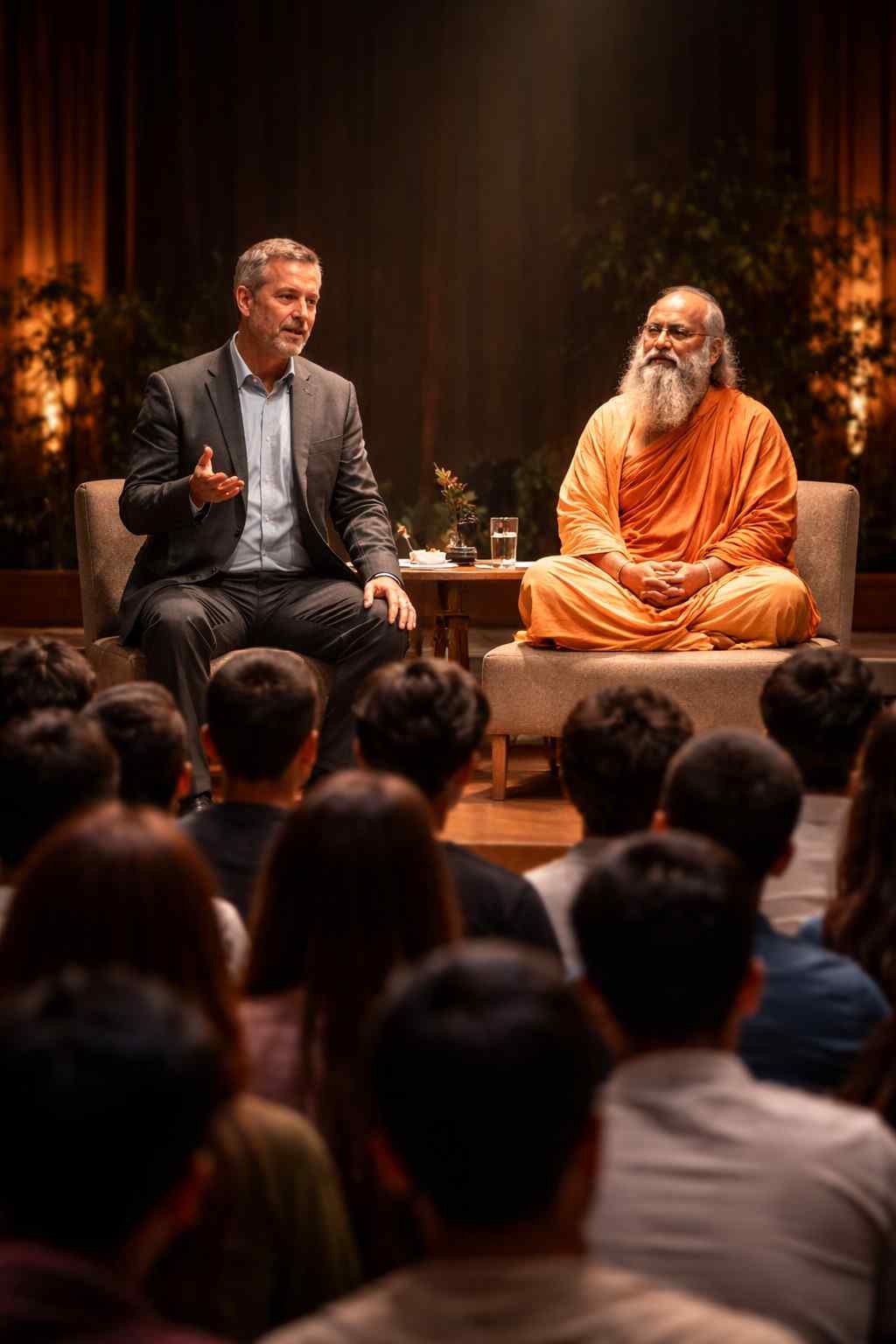

The auditorium was silent.
Not the kind of silence that comes from boredom…
but the kind that comes when people are thinking deeply.
It was an unusual event in Varanasi — a joint session between a Western psychologist and an Indian spiritual teacher.
Two very different worlds.
Two very different approaches.
And one topic that most people avoid.
At the center of the stage sat:
- Dr. Westero Reed — a well-known expert in Psychology
- Swami Anand — a calm, composed practitioner of Ayurveda and yogic philosophy
The audience was filled with young students.
Some curious.
Some confused.
Some already struggling silently.
The First Voice: Science Speaks
Dr. Reed stood up first.
He didn’t sound strict. He didn’t sound judgmental.
He spoke like someone who understood human behavior deeply.
“Let me begin with honesty,” he said.
“In modern psychology, we don’t label natural urges as ‘wrong.’ The human body is designed to experience impulses. Curiosity, attraction, desire — these are part of growing up.”
The students relaxed a little.
Finally, someone wasn’t scolding them.
“But,” he continued, his tone shifting slightly,
“There is a big difference between natural behavior… and compulsive behavior.”
He walked slowly across the stage.
“When something starts happening too frequently… when it becomes your primary way to deal with boredom, stress, or loneliness… then it is no longer harmless.”
He paused.
“And this is where many young people today are struggling — not because of the act itself, but because of lack of control.”
The Invisible Trap
Dr. Reed drew a simple diagram on the board.
Stimulus → Pleasure → Repeat
“This,” he said, “is how the brain learns.”
He explained the role of Dopamine
“When you repeatedly give your brain quick rewards,” he said,
“your brain stops enjoying slow, meaningful activities.”
He looked directly at the students.
“That’s why you feel:
- Less interest in studies
- Less excitement in real life
- More dependence on private habits”
The room was completely still now.
Because this felt real.
The Second Voice: Ancient Wisdom Speaks
Then Swami Anand stood up.
He didn’t use a board.
He didn’t use technical words.
But when he spoke… the entire room leaned in.
“In our tradition,” he began softly,
“we don’t just study the mind. We study the flow of energy within the body.”
He spoke about how Ayurveda views human development.
“What you eat,” he said,
“does not immediately become strength.”
He explained the transformation:
- Food becomes nourishment
- Nourishment becomes blood
- Blood becomes muscle
- Muscle becomes deeper tissues
- And after a long process… it becomes the most refined essence of the body
He paused.
“That final essence,” he said gently,
“is what sustains vitality, clarity, and life-force.”
He didn’t need to say more.
The message was clear.
“It takes time for the body to build its highest form of energy. But it can be lost very quickly if handled without awareness.”
Two Worlds, One Truth
The moderator smiled.
“This is interesting,” he said.
“One speaks in terms of brain chemistry. The other speaks in terms of life energy.”
Dr. Reed nodded.
Swami Anand smiled.
And then something unexpected happened.
They agreed.
The Point of Agreement
Dr. Reed spoke first:
“If a young person loses control over impulses, it affects focus, motivation, and emotional balance.”
Swami Anand added:
“If a young person does not protect and channel their energy, it affects strength, clarity, and inner stability.”
Different words.
Same truth.
A Student Stands Up
From the audience, a 15-year-old boy stood up hesitantly.
“Sir…” he said, looking at both of them,
“what should we do then?”
The question was simple.
But it carried the confusion of an entire generation.
The Practical Answer
Dr. Reed answered first.
“Don’t fight your mind with guilt,” he said.
“Understand your patterns.”
He suggested:
- Reduce exposure to triggering content
- Avoid long hours of isolation with screens
- Build healthy routines
“Your brain needs better habits,” he said.
Swami Anand continued.
“Don’t suppress your energy,” he said.
“Redirect it.”
He spoke about:
Brahmacharya
“Not as denial,” he clarified,
“but as mastery over your own impulses.”
He suggested:
- Physical activity to channel energy
- Discipline in daily routine
- Awareness of thoughts without reacting immediately
The Deeper Message
Then both of them spoke together.
Not planned. Not rehearsed.
But powerful.
“Your age is not for escaping into habits. Your age is for building yourself.”
What Happens If You Don’t Control Early?
Dr. Reed explained:
“You may grow older… but your mind will remain dependent.”
Swami Anand added:
“You may gain knowledge… but lose inner strength.”
What Happens If You Do Control Early?
Dr. Reed said:
“You build focus, discipline, and confidence.”
Swami Anand said:
“You build energy, clarity, and inner power.”
The Real Definition of Happiness
At the end of the session, the moderator asked one final question:
“What is happiness?”
Dr. Reed answered:
“A stable mind that is not controlled by impulses.”
Swami Anand answered:
“A strong inner state where your energy is not wasted but elevated.”
The Silent Impact
As the session ended, the students didn’t rush out.
They sat quietly.
Because something inside them had shifted.
Not fear.
Not guilt.
But understanding.
Final Message for Every Young Reader
You are growing up in a time where:
- Information is unlimited
- Temptation is constant
- Guidance is limited
That makes your awareness even more important.
Remember This Always
You don’t need to hate yourself.
You don’t need to feel ashamed.
But you do need to ask:
👉 “Is this making me stronger… or weaker?”
Because in the End
Both science and ancient wisdom agree on one thing:
“The person who learns to control their impulses early… builds a powerful life later.”
One Learning to Carry With You
“Discipline is not restriction — it is the path to real freedom.”