Vedic Wisdom · Identity · Inner Strength The Village You Left Is Not a Shame — It Is Your Strength A practical guide to keeping your identity intact when the big city calls — and the corporate world tries to swallow you whole. Rohan left Sitapur at 22 with one suitcase, a government job offer …

Vedic Wisdom · Identity · Inner Strength
The Village You Left Is Not a Shame — It Is Your Strength
A practical guide to keeping your identity intact when the big city calls — and the corporate world tries to swallow you whole.
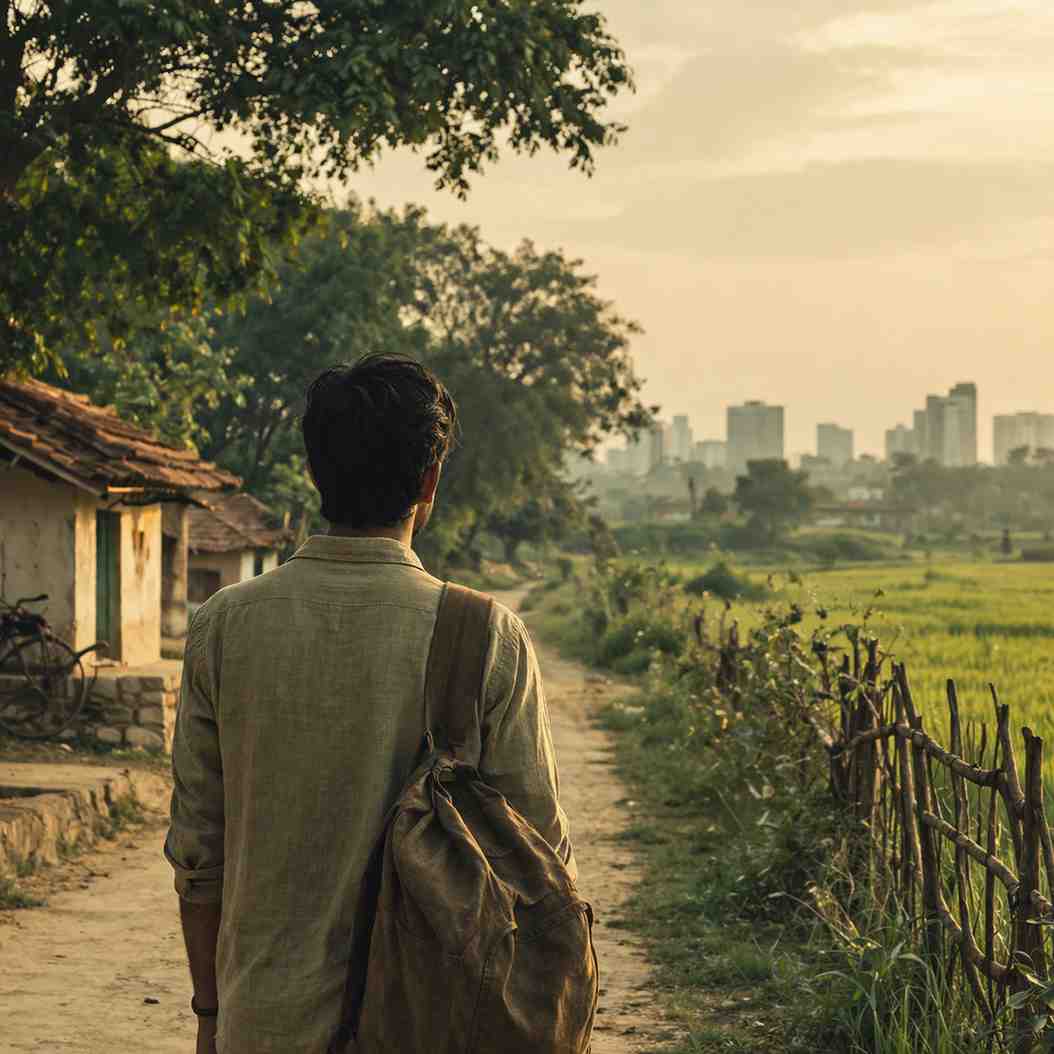
Rohan left Sitapur at 22 with one suitcase, a government job offer in Bengaluru, and a phone full of his mother’s voice notes about what to eat and how to pray. By the time he was 26, he had a new accent, a new wardrobe, a new habit of laughing along when colleagues mocked “small-town types” — and a quiet, persistent feeling that he could not name.
It was the feeling of a man who had traded himself in, piece by piece, without noticing the price.
If you have moved from a village, a qasbah, a small town — to Mumbai, Delhi, Bengaluru, Pune — this story is for you. Not because you have done something wrong. But because the city is designed to make you forget where you came from. And forgetting, in the Vedic tradition, is the root of all suffering.
01 — Recognise the Problem: When Adapting Becomes Erasing
Asmita — the distortion of identity
There is a difference between adapting and erasing. Adaptation is intelligent — you learn the city’s rhythms, its codes, its professional language. That is survival, and it is necessary. Erasing is something darker. It is when you stop mentioning your hometown. When you correct your mother’s Hindi in front of colleagues. When you drink at office parties not because you want to, but because saying no feels like wearing your village on your sleeve.
Patanjali calls this asmita — the confusion of the self with external identity. You begin to believe that you are what people see, rather than what you are. The city offers you a shiny new costume, and slowly, you forget it is a costume. You begin to call it skin.
“The man who is ashamed of his roots cannot grow. A tree that denies its soil does not become free — it dies standing.”
Here are the signs the erosion has begun:
- You avoid telling new colleagues where you are from
- You feel a flash of shame when your parents call in front of others
- You drink, eat meat, or stay out late — not by choice, but to avoid standing out
- You have stopped doing the things that once made you feel like yourself — prayer, fasting, simple food, early rising
- You feel vaguely fraudulent — neither fully “city” nor comfortably yourself
This discomfort is not weakness. It is your soul sending a distress signal. Learn to read it.
02 — The Vedic Answer: Your Roots Are Karma, Not Coincidence
Karma and Kula — the soul chooses its origin
The Vedic worldview does not believe you were born in your village by accident. The family, the soil, the culture, the language you arrived into — these were chosen by the karma of your previous lives. Your origin is not a random cosmic mistake that the city is giving you a chance to correct. It is the very foundation upon which your dharma — your life’s purpose — is meant to be built.
“Janma karma cha me divyam evam yo vetti tattvatah.”
Bhagavad Gita, Chapter 4, Verse 9 — One who knows the divine nature of my birth and actions does not take birth again after leaving the body — he attains Me.
Krishna is speaking of his own divine birth — but the principle extends to all souls. Your birth was not random. Your kula — your family lineage — carries specific qualities, values, and ways of seeing the world that are yours to steward, not abandon.
The farmer’s son who becomes a software engineer carries within him something the city-born engineer does not: a bone-deep understanding of patience, of seasons, of how long real things take to grow. The small-town boy who moved to Mumbai carries frugality, community loyalty, and a suspicion of shortcuts that are, in the long run, enormous professional and personal assets — if he does not spend his twenties hiding them.
Your roots are not your limitation. They are your original capital. The city gives you a market. Your roots give you something worth selling.
03 — The Law of Destiny: What Is Yours Will Not Require You to Betray Yourself
Prarabdha — the portion of karma already in motion
Rohan noticed something in his fourth year. The colleague who mocked small-town types the loudest was passed over for the promotion. The manager who got it was a quiet woman from Nashik who never pretended to be anything other than what she was — sharp, grounded, unshakeable. She had never laughed at anyone’s accent, including her own.
The law of prarabdha karma is simple: the opportunities, relationships, and outcomes that are meant for you will find you when you are most fully yourself — not when you are performing a version of yourself designed to please a room.
Every compromise of identity to fit in is a small bet that your destiny is too fragile to survive your authenticity. That bet is almost always wrong.
“What is destined for you will not pass you by simply because you refused to drink. It will pass you by only if you become someone else while waiting for it.”
Low-worry attitude is built on this foundation. You do not need to perform your way into your destiny. You need only show up as yourself, do your work with full sincerity, and trust that the law of karma is more precise than any office politics you will ever navigate. Dont worry much…
- Ask before every social compromise: “Am I doing this by choice, or by fear?”
- Fear-based choices erode identity. Choice-based choices build it
- What the right people respect about you is exactly what the wrong people want you to hide
- Your destiny does not have a dress code that requires you to forget your mother tongue
04 — Stay Firm: On Drinking, Eating, and the Art of the Polite No
Svadhyaya — self-study, knowing what you stand for
Let us speak plainly about the booze question, because it comes up in every corporate story from every small town in India and it is never really about booze.
It is about belonging. It is about the terror of the Friday evening when everyone heads to the bar and you are standing there calculating whether your no will cost you an invisible point on some invisible scoreboard of who is “one of us.” That terror is real. But the solution to it is not in your glass.
Rohan tried saying yes for two years. He drank things he did not like, stayed at places that drained him, laughed at jokes that were not funny — all to belong. What he discovered at the end of those two years was that he belonged nowhere. Not to his new colleagues, who respected his performance but did not actually know him. Not to himself, because he had made himself unrecognisable.
The firm no is a spiritual act. It says: I know who I am. I know what I value. And I like you enough to be honest with you about it rather than perform for you.
“I don’t drink — but I’ll stay for the conversation. Get me a lime soda.”
This one sentence, said with a smile and zero apology, has built more genuine corporate relationships than a thousand rounds of reluctant drinking.
The same applies to vegetarian food at meat-heavy office lunches. To skipping the late-night party because you wake at 5am to meditate or exercise. To taking a personal day on Ekadashi. You do not owe anyone an elaborate justification for living according to your values. A calm, warm, unapologetic explanation once is enough. After that, repetition is dignity.
- “I don’t drink” — full stop. No lengthy medical excuse needed
- Stay for the social occasion, participate fully in everything else — the conversation, the laughter, the connection
- People respect clarity far more than they respect compliance
- The colleagues who mock your no are telling you about their own insecurity, not your unsuitability
05 — Never Be Ashamed: Your Past Is Your Credential
Swabhimaan — self-respect rooted in truth
There is a particular kind of urban snobbery that thrives in Indian corporate culture — the quiet ranking of people by which city they are from, which college, which accent. It is mostly unconscious. It is also mostly projection. The people doing the ranking are usually the most insecure people in the room.
Here is what they do not tell you in orientation week: the qualities that small-town India produces are exactly the qualities that large organisations desperately need and chronically lack. Patience. Loyalty. Cost-consciousness. The ability to work without constant validation. Comfort with simplicity. Real relationships built over time rather than transactional networking. Groundedness under pressure.
The city produces brilliant, ambitious, restless people. The village produces deep, reliable, rooted people. The most effective professionals are those who bring both — and the only way to bring both is to refuse to leave one behind at the bus stand when you arrived.
“I grew up in a small town in UP. It taught me things no MBA could — how to negotiate without aggression, how to build trust over time, how to do more with less. I consider it my best qualification.”
Say this in your next interview and watch the room shift.
Rohan stopped hiding Sitapur in his fifth year. He mentioned it in a team meeting when discussing a rural-market research project. His manager — a Mumbaikar who had never been north of Delhi — looked at him differently from that day. Not with pity. With the particular respect one gives to someone who actually knows something.
06 — Don’t Be a Yes-Man: Belonging Is Not the Same as Dissolving
Satya and Swadharma — truth and one’s own path
The yes-man trap in a corporate city setting is subtler than just saying yes to drinks. It is saying yes to a value system that is not yours. Yes to the idea that ambition must look a certain way. Yes to the belief that your accent needs correcting. Yes to the unspoken rule that having come from a small town is something to outrun rather than build upon.
The Bhagavad Gita is emphatic on this point. In Chapter 3, Verse 35, Krishna says something that cuts through all social pressure with surgical precision:
“Shreyan swadharmo vigunah paradharmat svanushthitat.”
Bhagavad Gita, Chapter 3, Verse 35 — It is far better to perform one’s own dharma imperfectly than to perform another’s dharma perfectly. It is better to die in one’s own dharma — another’s dharma brings danger.
Your swadharma — your own nature, your own path — is not a handicap. It is a compass. When you follow someone else’s dharma, even perfectly, you are always slightly off-course. The energy expenditure of maintaining a false self is enormous and invisible — it is the reason so many corporate migrants feel exhausted in ways that sleep cannot fix.
Belonging and dissolving are not the same thing. True belonging — the kind that sustains you — happens when people know who you actually are and choose to include you. False belonging — the kind that exhausts you — is when a performance of yourself gets included and you have to keep performing to stay.
- You can be warm, socially skilled, and fully yourself — these are not contradictions
- Speak your mind at work. Disagree politely. Offer the perspective that only your background can offer
- The goal is not to be liked by everyone — it is to be genuinely valued by the right people
- One authentic friendship in the city is worth twenty transactional ones
07 — Skills to Build: The Three-Year Plan for the Rooted City-Dweller
Abhyasa — deliberate practice, year by year
Keeping your identity intact is not passive. It requires active, deliberate building — of skills, habits, and anchors that keep you connected to who you are even as the city pulls at you from every direction. Here is a three-year plan built for exactly this.
Year One — Establish Your Anchors
The first year in a new city is the most dangerous for identity. Everything is new, exciting, and slightly overwhelming. This is when the erosion happens fastest — not through dramatic decisions but through a hundred small ones that accumulate unnoticed. Your job in Year One is to establish non-negotiable anchors.
- Keep one daily practice from home — morning prayer, meditation, a simple ritual that takes five minutes and costs nothing
- Call your parents at the same time every day — not out of obligation, but as an anchor to where you came from
- Find one person in the city who shares your values — not necessarily your background, but your orientation toward life
- Learn to cook two dishes from home — the act of making familiar food in a strange kitchen is quietly powerful
Year Two — Build City Skills Without City Values
By Year Two, the city’s rhythms feel more familiar. This is when you can deliberately acquire the skills the city offers without accepting the entire value package that sometimes accompanies them. Learn to network without becoming transactional. Learn to negotiate without becoming aggressive. Learn to present yourself professionally without becoming fake.
- Develop professional communication skills — spoken English, email writing, presentation — these are tools, not replacements for your personality
- Study your industry seriously — become the most knowledgeable person in your team on one specific thing
- Build financial literacy — savings, investment, insurance — the frugality from home is your edge, use it consciously
- Practise saying no in low-stakes situations so it becomes natural in high-stakes ones
Year Three — Integrate and Give Back
By Year Three, if you have done the inner work, something shifts. You stop feeling like a visitor in the city and start feeling like someone who has genuinely expanded — not replaced — who they are. This is the year to integrate both worlds consciously, and to begin giving something back to the place you came from.
- Mentor someone newer who has made the same journey — your experience is now someone else’s map
- Visit home not as someone who has escaped, but as someone who has expanded — bring something useful back
- Identify the unique perspective your background gives you professionally and begin naming it, owning it, using it as a strength
- Build a life in the city that you would not be ashamed to show your parents — that test is more clarifying than any values exercise
“The goal is not to choose between your village and your city. The goal is to become someone large enough to hold both.”
A Practical Daily Checklist for the Rooted City-Dweller
Identity is not preserved in grand gestures. It is preserved in daily small ones. Here is a simple daily checklist:
- Did I do my morning practice today — even for five minutes?
- Did I speak to someone from home?
- Did I say yes to something I meant no to — and why?
- Did I do my work with sincerity, or was I performing for approval?
- Am I sleeping at a time that honours my health, or at a time that performs my belonging?
Five questions. Two minutes. The difference between a life that accumulates quietly into something meaningful and a life that evaporates into a performance no one — including you — was ever watching.
The Final Word
Rohan went back to Sitapur for Diwali in his fifth year. He sat on the charpoy in the courtyard, ate his mother’s dal baati, watched the diyas flicker, and felt — for the first time in years — that he was fully present somewhere.
Not performing. Not calculating. Not managing an impression.
Just himself. The city version and the village version, finally sitting quietly in the same body.
That is the only arrival that matters. Everything else is just transit.