The House Is Full. The Heart Is Empty. For the saas who cooked for everyone, prayed for everyone, sacrificed for everyone — and still goes to sleep feeling utterly alone. Savitri Devi woke at five every morning. She made chai for six people. She remembered everyone's preferences — her son liked it strong, her bahu …
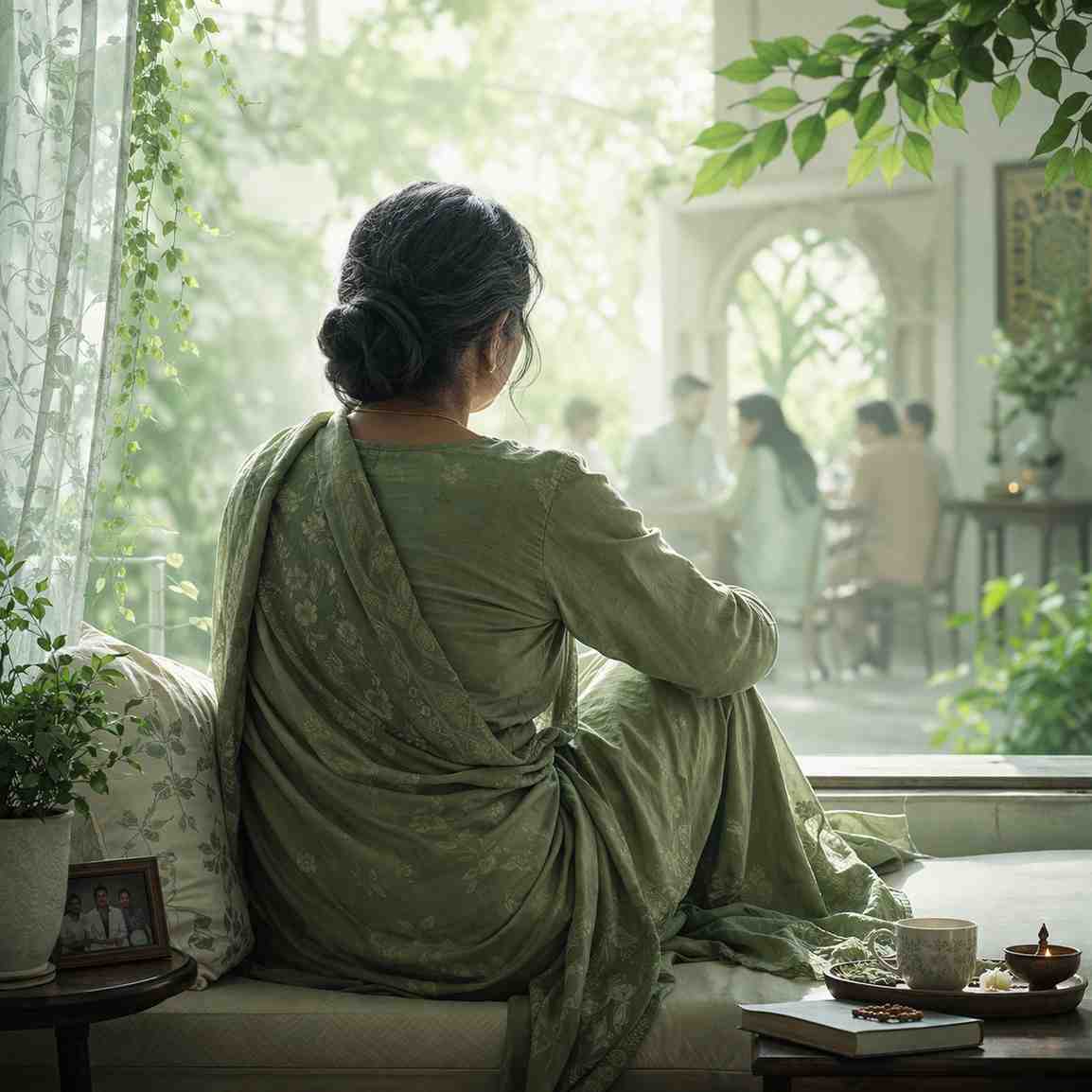

The House Is Full. The Heart Is Empty.
For the saas who cooked for everyone, prayed for everyone, sacrificed for everyone — and still goes to sleep feeling utterly alone.
Savitri Devi woke at five every morning. She made chai for six people. She remembered everyone’s preferences — her son liked it strong, her bahu liked it with less sugar, the grandchildren wanted it more milk than tea. She remembered the doctor’s appointments, the school timetables, the days when the pressure cooker whistle needed to be softer because the baby was sleeping.
She remembered everything about everyone.
Nobody remembered her.
Not her birthday — which passed last month with a WhatsApp message from her son sent at 11pm, probably reminded by his phone. Not the anniversary of her husband’s death, which she observed alone in the puja room while the rest of the house watched television. Not the fact that she had not left the colony in three weeks, that her knees hurt in the evenings, that she had been coughing since Tuesday and nobody had noticed.
She was not ignored out of cruelty. She was ignored out of assumption — the assumption that she was fine, that she was always fine, that being needed was the same as being loved, that a woman who serves so completely must therefore be completely fulfilled.
Savitri Devi sat in her kitchen after everyone left for school and office, held her own cup of chai — made last, lukewarm — and felt something she did not have a word for. Not sadness exactly. Not anger. Something quieter and more total. The feeling of being surrounded by your own life and somehow absent from it.
If you recognise this feeling — this specific, particular loneliness of the woman at the centre of a full house — this is written for you.
01 — Recognise the Problem: The Loneliness Nobody Names
Viveka — the discrimination to see things as they truly are
The loneliness of the saas is one of the most common and least spoken-about experiences in the Indian household. It is invisible for several reasons. First, because she is surrounded by people — and in a culture that equates physical solitude with loneliness, a woman in a full house is assumed to be fine. Second, because she herself does not name it. She has been taught that her needs are secondary, that wanting to be seen and known and cherished is somehow indulgent, that a good mother and mother-in-law finds her purpose in service and asks for nothing more.
Third — and this is the hardest part — because naming it feels like an accusation. To say “I am lonely” in a house full of family feels like saying “you have all failed me.” And she loves these people. She does not want to accuse them. So she says nothing. And the loneliness deepens, unaddressed, into something that begins to shape everything — her mood, her health, her relationship with her bahu, her relationship with her son, her relationship with herself.
“To be needed is not the same as to be known. To be useful is not the same as to be loved. The woman who confuses these two things will serve her whole life and still go hungry.”
The signs of this particular loneliness:
- You feel most alone not when the house is empty, but when it is full and noisy and you are somehow not part of it
- Nobody asks how you are — and when they do, it is in passing, not really waiting for an answer
- Your conversations have become functional — about food, schedules, children — never about you
- You have opinions, memories, stories, and inner weather that nobody in the house knows about
- You feel that if you stopped doing everything tomorrow, people would notice the gap in service — not the gap of you
- You cry sometimes, quietly, in the puja room or the kitchen, and then compose yourself before anyone sees
This is not self-pity. This is a real and serious condition of the soul. It deserves to be named. It deserves to be addressed — not with blame, but with clarity and compassion and practical wisdom.
02 — The Vedic Answer: Even the Goddess Had Her Own Nature
Swabhava — one’s own essential nature, which must be honoured to remain whole
The Vedic tradition speaks at length about swabhava — one’s essential nature, the particular quality of being that a soul brings into this world. Not the roles it plays — mother, wife, daughter-in-law — but the irreducible, individual nature underneath the roles. Every soul has a swabhava. And when that nature is consistently suppressed, ignored, or starved of expression, the soul does not disappear. It aches.
Even the great goddesses of the Vedic tradition are not defined only by their relationships. Saraswati is not merely the consort of Brahma — she is the goddess of learning, music, and creative intelligence in her own right. Lakshmi is not merely the wife of Vishnu — she is the sovereign principle of abundance and grace. Their identities exist independently of their relational roles.
“Ya Devi sarvabhuteshu, Matri rupena samsthita. Namastasyai, namastasyai, namastasyai namo namah.”
Devi Mahatmyam — Salutations to the Goddess who resides in all beings in the form of the Mother — not as a function, but as a divine presence.
The tradition honours the mother — but as a divine presence, not as a domestic function. Savitri Devi’s loneliness is, in the Vedic frame, the loneliness of a divine presence that has been reduced to a domestic function. The correction is not to stop being a mother. It is to remember — and insist — that you are also a soul with a swabhava that has nothing to do with cooking, scheduling, and remembering everyone else’s preferences.
What was your nature before you became a mother? Before you became a saas? What did you love? What made you feel most fully yourself? Those questions are not nostalgia. They are navigation.
03 — The Law of Karma: You Cannot Pour From an Empty Vessel
Dharma of the self — the primary duty to remain whole
Here is something that the selfless saas needs to understand about karma: the quality of what you give is inseparable from the state of the one giving. A woman who gives from depletion, from loneliness, from unexpressed need — gives differently than a woman who gives from fullness. The food tastes different. The presence feels different. The love lands differently.
The children and grandchildren in Savitri Devi’s house were absorbing something from her daily — not just nutrition and care, but the energetic quality of the giver. A grandmother who is quietly hollow teaches, without a word, that this is what love costs. That to be a good woman is to be an invisible one.
Her granddaughter was watching everything. Learning what it means to be a woman in a family. Learning whether a woman’s inner life matters. Learning whether joy is something women are allowed or something they must wait for permission to have.
“The grandmother who tends her own inner life gives her granddaughter something no amount of cooking and sacrifice can give — the sight of a woman who knows she is worth tending.”
Tending yourself is not selfishness. In the economy of karma, it is the most generous long-term investment you can make in the people you love. A full presence nourishes. A depleted one, however well-intentioned, quietly drains.
- Your wellbeing is not separate from your family’s wellbeing — it is the foundation of it
- The karma of joyful giving is entirely different from the karma of resentful sacrifice — even when the action looks identical from outside
- What your granddaughter learns from watching you is more powerful than anything you will ever tell her
- Refilling yourself is not indulgence — it is maintenance of the most important resource your family has
04 — The Law of Destiny: This Stage of Life Has Its Own Dharma
Ashrama dharma — the specific duty of each stage of life
The Vedic tradition divides life into four ashramas — four stages, each with its own dharma, its own purpose, its own appropriate way of living. The first is Brahmacharya — the student stage. The second is Grihastha — the householder stage of marriage, children, family. The third is Vanaprastha — the forest dweller stage, where the householder begins to step back from active management of the family and turn inward. The fourth is Sannyasa — the stage of full renunciation and spiritual focus.
The saas, in most cases, is at the threshold of Vanaprastha. Her children are grown. Her primary parenting duties are complete. The tradition is explicitly clear: this is the stage to begin loosening — not abandoning love, but releasing the grip of management, of control, of being indispensable to everyone’s daily functioning.
“Grihe putraan pratishthapya, vanam gacchhet vicakshanah.”
Manu Smriti — Having established the children in the household, the wise one should turn toward the forest — toward inner life, toward reflection, toward oneself.
The loneliness of the saas is partly the pain of a woman who has not yet made this transition — who is still trying to live the Grihastha dharma of active management in a stage that is calling her toward something quieter and deeper. The family has outgrown its need for her daily management. But nobody has told her that this is not abandonment — it is evolution. And that the stage ahead, if she enters it consciously, is the richest one yet.
Low-worry attitude, at this stage of life, means trusting that the family will manage without your constant management. It always was going to. Your destiny now is not to run the household. It is to deepen — your spiritual practice, your relationships, your inner life, your own becoming.
05 — Stay Firm: Ask for What You Need. Out Loud.
Satya — truth spoken with love, including about your own needs
The saas rarely asks for what she needs. She was trained not to. A lifetime of putting others first has made her fluent in everyone’s needs and a stranger to her own. And even when she feels the loneliness acutely, she does not name it — because naming it feels like weakness, like complaint, like the behavior of a woman who did not sacrifice enough to earn her place.
This silence is a form of untruth. Not malicious — habitual. And like all sustained untruth, it has consequences. The family around her genuinely does not know she is lonely. They are busy, absorbed in their own lives, operating on the assumption that she is fine because she has always appeared fine. Her silence is being read as contentment. Her service is being read as fulfilment.
When Savitri Devi finally told her son — quietly, one evening when he was alone — that she felt invisible in her own home, he looked at her with a kind of shock that contained both surprise and guilt. He had not known. He genuinely had not known. Not because he did not love her, but because she had never told him, and he had never thought to ask.
“Your family cannot give you what they do not know you need. Your silence, however dignified it feels, is depriving them of the chance to love you well.”
- Tell one person — your son, your bahu, a trusted friend — one true thing about how you feel. Not a complaint. A truth.
- Ask for specific, small things — a walk together once a week, a conversation at dinner that includes you, a phone call that is not about logistics
- Do not wait to be noticed — notice yourself first, and then make yourself known
- Practise receiving — when someone offers help, attention, or care, do not deflect it. Say yes. Let it land.
- Your needs are not a burden on the family. They are an invitation to love you more fully.
06 — Do Not Be a Yes-Woman to Invisibility
Swabhimaan — the self-respect that says: I am here, I matter, I will not disappear quietly
Invisibility, like all forms of erasure, requires the cooperation of the person being erased. The saas becomes invisible partly because the family ignores her — and partly because she agrees to be ignored. She steps back from conversations. She eats last and least. She declines the outing because someone needs to stay home. She says “I am fine” when she is not fine, and over time the family stops checking because the answer is always the same.
Refusing invisibility does not mean becoming demanding or dramatic. It means small, consistent acts of presence. Joining the conversation even when it is about something you are not expected to have opinions on. Sharing a memory, a story, a point of view — and not retreating when no one immediately responds. Taking up space at the dinner table — not more space than anyone else, but your own space, fully.
Savitri Devi began, slowly, to do this. She started telling stories at dinner — stories from her own childhood, from her early married life, from the years before any of the people at the table existed. Her grandchildren, who had never thought of her as someone with a past, began to listen with a curiosity she had not expected. Her bahu, who had always seen her as a function rather than a person, began to see something else.
“The woman who shares her stories gives her family a gift they did not know they needed — the knowledge that she was, and is, a full human being. Not just their saas. A person.”
07 — Skills to Build: The Three-Year Journey Back to Yourself
Abhyasa — consistent, patient practice of returning to your own life
Year One — Rediscover Your Own Company
The saas who has spent decades focused entirely outward has often lost the ability to enjoy her own company. Solitude feels like loneliness because she has not yet learned to distinguish between the two. Loneliness is the pain of unwanted aloneness. Solitude is the pleasure of chosen aloneness. Year One is about learning the difference — through small, deliberate experiments in being alone with yourself without immediately filling the time with service to others.
- Reclaim one hour daily that is entirely yours — not prayer for the family, not worry about the family. Yours.
- Revisit one thing you loved before the decades of family management — bhajans, gardening, reading, stitching, walking — and do it without justifying it to anyone
- Reconnect with one friend from your own life — not a neighbour, not a family connection, but someone who knew you before you were anyone’s saas
- Keep a simple diary — not of family events, but of your own thoughts, feelings, and small daily observations. The practice of witnessing your own inner life is profoundly restorative
Year Two — Deepen Your Spiritual Life on Your Own Terms
Most saas women already have a spiritual practice — but it is often oriented entirely outward. Fasting for the son’s health. Praying for the grandchildren’s exams. Visiting the temple for the family’s wellbeing. Year Two is about developing a spiritual practice that is for you — your own relationship with the divine, your own inner journey, your own peace.
- Choose one scripture, one text, one set of bhajans that speaks to your own soul — and study or practice it for yourself, not for anyone else
- Find a satsang, a spiritual group, a class — something that takes you regularly outside the house into a community of people who know you as a spiritual being, not as a domestic one
- Practise sitting in silence for ten minutes each morning before the household wakes — not to plan the day, but to simply be present with yourself
- Consider a pilgrimage — even a small local one — that is for you alone, or with a friend, not organised around the family’s convenience
Year Three — Become the Elder the Family Needs, Not the Servant It Has
The Vedic tradition has a beautiful concept of the elder — not the person who manages the household from a position of control, but the person who holds the family’s deeper memory, values, and spiritual orientation. The wise elder is the one the family turns to not for logistics, but for perspective. Not for cooking, but for counsel. Year Three is about consciously stepping into this role — which requires stepping out of the servant role that exhaustion and habit have locked you into.
- Begin telling your stories — to your grandchildren especially. Your memories, your struggles, your early life. These are the family’s living history and they are stored only in you
- Offer wisdom when asked — and wait to be asked, rather than volunteering advice that reads as criticism
- Deliberately hand over domestic responsibilities you have been holding — not all at once, but gradually, with the explicit message that the next generation is capable
- Model the Vanaprastha stage visibly — let the family see a woman who is turning inward with curiosity and peace rather than being dragged there by irrelevance
“The saas who becomes the family’s wise elder gives them something no amount of service ever could — a living example of how to age with dignity, depth, and grace.”
A Daily Practice for the Saas Who Is Returning to Herself
Five minutes. Every morning. Before the chai is made for anyone else.
- Sit quietly and ask: what do I feel today — not about the family, but about myself?
- Name one thing that is yours today — one small pleasure, one small intention, one small act of self-remembering
- Say a prayer that is for you — not for the son’s promotion or the grandchild’s health, but for your own peace, your own clarity, your own joy
- Make your chai first. Drink it hot. Before anyone else wakes up. This is not selfishness. This is the beginning.
The Final Word
Savitri Devi joined a bhajan group that met on Tuesday mornings. She told nobody it was for her. She said it was for her spiritual practice — which was true, but not the whole truth. The whole truth was that for two hours every Tuesday, she was not anyone’s saas or anyone’s mother. She was just Savitri. A woman with a voice that the others said was beautiful. A woman who laughed at things she found funny without checking if the laughter was appropriate. A woman who, for two hours a week, was completely, unapologetically present in her own life.
She came home from the first session and made the best dal of her life. Her son noticed. He did not know why it tasted different. She did.
A woman who has been to herself and come back — she cooks differently. She loves differently. She fills the house with something no recipe can produce and no amount of sacrifice can manufacture.
She fills it with her actual presence. And that changes everything.
Tags: Vedic Living · Saas · Mothers · Loneliness · Identity · Ashrama Dharma · Family · Inner Strength · Ageing with Grace