The Device That Ate the World A Satirical Tragedy in Five Acts — About How Eight Billion People Voluntarily Walked Into the Most Elegant Cage Ever Built Prologue — The Most Important Invention Since Fire Somewhere in a Silicon Valley boardroom in 2007, a man in a black turtleneck held up a small rectangular slab …
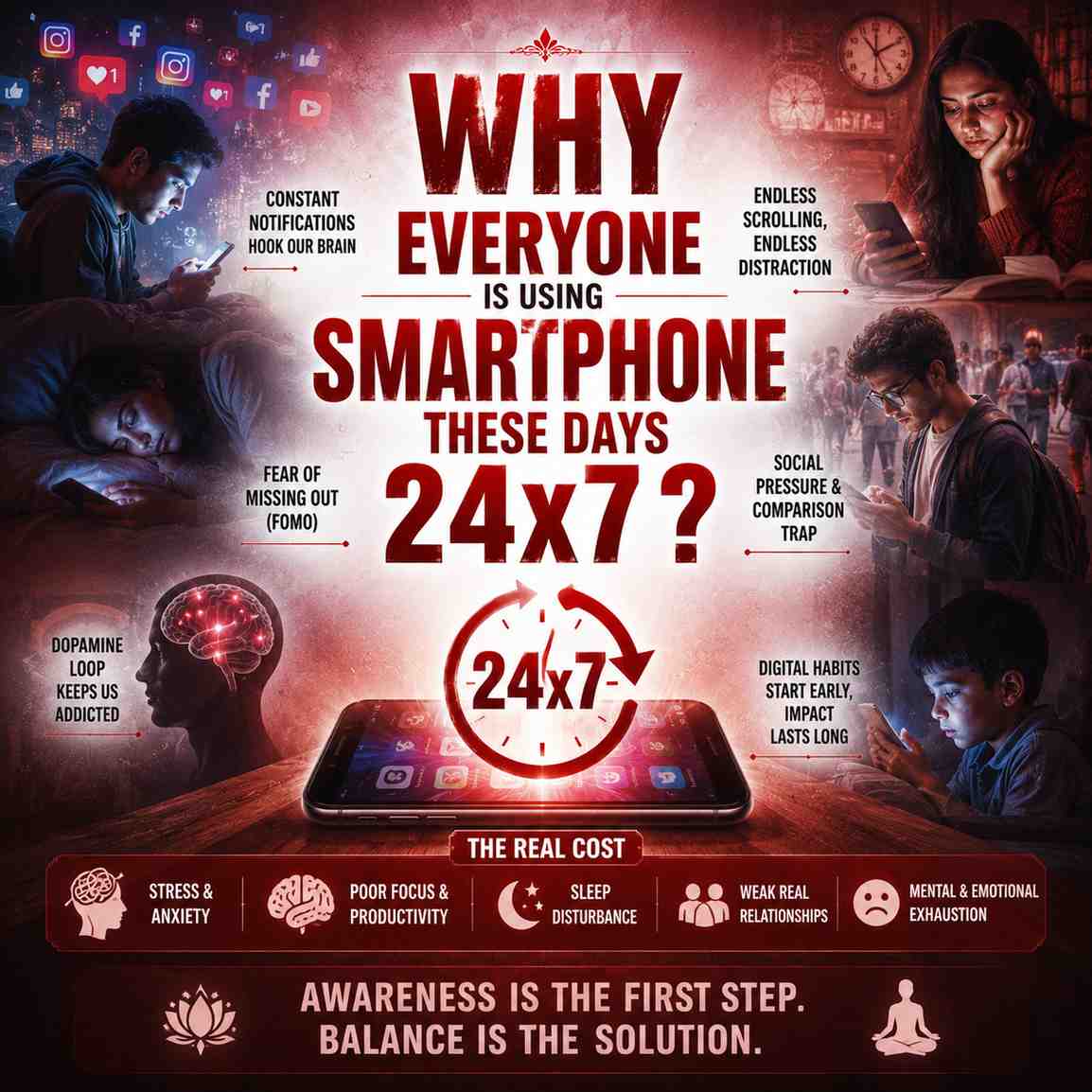

The Device That Ate the World
A Satirical Tragedy in Five Acts — About How Eight Billion People Voluntarily Walked Into the Most Elegant Cage Ever Built
Prologue — The Most Important Invention Since Fire
Somewhere in a Silicon Valley boardroom in 2007, a man in a black turtleneck held up a small rectangular slab of glass and metal.
“Today,” he said with the rehearsed breathlessness of a prophet, “Apple is going to reinvent the phone.”
The crowd went wild.
They did not know — could not have known — that what was being reinvented was not just the phone.
What was being reinvented was the human being.
Act One — The Perfect Trap
Let us be honest about one thing.
The smartphone is, without question, the most extraordinary object human beings have ever created.
It is a camera, a compass, a library, a telephone, a television, a torch, a translator, a newspaper, a bank, a map, a diary, a radio, a doctor’s appointment, a ticket booking system, a love letter, and — on particularly desperate evenings — a substitute for human companionship.
It fits in your pocket.
It costs less than a month’s salary for most people.
It has democratised information in ways that would have seemed miraculous to any generation that came before.
This is all true.
And this is exactly what makes it the most perfect trap in human history.
Because the best traps do not look like traps.
They look like gifts.
The engineers who built the first social media platforms — the Facebooks, the Twitters, the Instagrams — were, in the beginning, idealistic. They genuinely believed they were connecting humanity. Building bridges. Shrinking the world.
What they were actually building — and what they discovered with considerable glee somewhere around 2010 — was a machine for harvesting human attention.
And human attention, it turned out, was worth more than oil.
More than gold.
More than any physical resource ever dug from the ground.
Because attention — sustained, monetised, sold to the highest advertiser — was infinite. Renewable. Self-replenishing. And best of all, the people giving it away thought they were getting something for free.
They were not.
They were the product.
They just did not read the Terms and Conditions.
Nobody reads the Terms and Conditions.
Act Two — The Science of Making You Scroll Forever
Here is something the engineers knew that they did not tell you.
The notification sound your phone makes — that little ping — was designed in a laboratory.
Not designed the way a chair is designed, for comfort. Designed the way a casino slot machine is designed, for addiction.
B.J. Fogg at Stanford University built an entire academic discipline called Persuasive Technology — the science of using design to change human behaviour. His students, the brightest young minds of their generation, went on to build the platforms you cannot stop using.
One of his students later said — publicly, in a Senate testimony — “I feel tremendous guilt. I think we have created tools that are ripping apart the social fabric.”
That student was the founding president of Facebook.
The tools kept running.
The guilt did not stop them.
Because the tools were making too much money.
Here is what the dopamine loop looks like, in technical terms:
You post something — a photograph, an opinion, a joke.
You feel a small anxiety. Will people like it?
A notification arrives. Someone liked it.
Dopamine releases in your brain. A small reward. Identical — neurologically identical — to what happens when a rat in a laboratory presses a lever and receives a food pellet.
You post again.
The cycle repeats.
A hundred times a day.
A thousand times a week.
The engineers call this engagement.
What they mean is dependency.
The word they use for you is user.
Consider that word carefully.
User.
The same word we use for someone addicted to heroin.
Act Three — What We Lost While We Were Looking Down
There is a family sitting at a dinner table in Mumbai.
Or Delhi. Or Chennai. Or Pune. Or London. Or Tokyo. It does not matter. The scene is universal now. Borders are irrelevant in the attention economy.
The father is watching cricket highlights on his phone.
The mother is in a WhatsApp group argument about a school event.
The teenage daughter is watching a fifteen-second video of a stranger dancing.
The eight-year-old son is playing a game designed by behavioural psychologists to be as difficult to stop as possible.
The grandmother is sitting at the end of the table, eating slowly, saying nothing.
She grew up in a village where dinner was the event of the day. Where family ate together and talked and argued and laughed and someone always told a story about something that happened forty years ago that everyone had heard a hundred times but nobody minded hearing again.
She does not understand what happened.
She is not wrong to be confused.
What happened is that four separate companies — headquartered in California — redesigned the most intimate ritual of human civilisation.
And charged nothing for it.
Because they made their money elsewhere.
They made it from selling the grandmother’s granddaughter’s attention to a fairness cream company.
Here is a partial inventory of what we lost while we were looking at screens:
Boredom. Which sounds like a small loss until you realise that every important creative idea in human history came from a bored mind that had nothing to do and began to wander. Newton was bored under a tree. The entire tradition of Indian philosophical thought came from monks who had nothing but time and silence. We have abolished boredom. We have also, quietly, been abolishing the conditions for original thought.
Patience. The average attention span — measured by Microsoft in 2015 — had fallen below that of a goldfish. Eight seconds. The Mahabharata took years to compose and years to learn. The Upanishads were designed to be meditated upon for lifetimes. We now lose interest in a video if it does not hook us in the first three seconds.
Memory. We no longer remember phone numbers, addresses, birthdays, directions, recipes, poetry, or the names of the people we were introduced to last week. We have outsourced our memory to a device. Which is fine until the device is lost. Or hacked. Or simply decides that the Terms and Conditions have changed.
Silence. The average person now reaches for their phone within ninety seconds of waking up. Before they have looked at the sky. Before they have spoken to another human being. Before they have had a single thought that originated entirely from within themselves. The first voice they hear every morning is not their own.
Deep reading. The ability to follow a sustained argument across many pages — the fundamental skill required to understand philosophy, science, history, law, literature — is eroding measurably in populations that are heavy smartphone users. The Bhagavad Gita has seven hundred verses. The average Reel is fifteen seconds. These are not compatible cognitive habits.
The present moment. Which was always, in every spiritual tradition from the Upanishads to the Stoics to the Buddhist monks, the only place where real life actually happens.
Act Four — The Culture Machine
Now let us talk about culture.
Because this is where it gets genuinely sinister.
Culture — the values, the stories, the shared assumptions that make a civilisation — is not created by politicians or governments or armies. It is created slowly, organically, across generations, through the accumulated weight of what people do, what they celebrate, what they shame, what they tell their children.
For ten thousand years, culture was made by humans talking to other humans.
Then came mass media — newspapers, radio, cinema, television. Culture could now be manufactured and distributed at scale. This was powerful. Sometimes it was used well. Often it was not.
But even then, culture was local. Indian culture was Indian. Japanese culture was Japanese. The Yoruba people of Nigeria had their own stories, their own rhythms, their own sense of what mattered.
The smartphone changed this.
Not by force. Not by war. Not by colonisation in the old brutal sense.
By preference.
By giving everyone on earth access to the same fifteen-second videos produced by the same algorithms optimised for the same neurological responses.
A fourteen-year-old girl in Varanasi and a fourteen-year-old girl in São Paulo and a fourteen-year-old girl in Lagos now largely want the same things, dress the same way, speak the same slang, fear the same social judgements, and measure their worth by the same metric — the number of people who double-tapped a photograph of their face.
This is not connection.
This is homogenisation.
This is the quiet, cheerful, entirely voluntary replacement of ten thousand years of human cultural diversity with a single monoculture — designed not by artists or philosophers or priests or grandmothers, but by engagement algorithms that have no values whatsoever except the maximisation of time-on-platform.
The grandmothers, all over the world, are sitting at the ends of dinner tables, eating slowly, saying nothing.
They are watching the last generation that knew something different grow older.
Let us speak specifically about India.
India had something that almost no other civilisation in human history possessed — an unbroken philosophical tradition stretching from the Vedas to the present day. A tradition that had, within it, profound and sophisticated answers to the questions that Big Tech is now raising for the first time.
Questions like:
What is the self? What is real and what is illusion? Where should our attention go? What is the relationship between the individual and the collective? What does it mean to live well?
Shankaracharya answered the attention question fourteen hundred years ago — “Bhaj Govindam.” Give your attention to what is real. The rest is Maya.
Patanjali, in the Yoga Sutras, defined yoga as “chitta vritti nirodha” — the cessation of the fluctuations of the mind. Every notification is a fluctuation. Every scroll is a fluctuation. Patanjali would look at the modern smartphone user and diagnose them immediately: profound, clinical, algorithmically-induced chitta vritti.
The Buddha taught that the root of suffering is craving — tanha. The like button is a craving machine. The follower count is a craving machine. The entire architecture of every major social platform is a craving machine, designed with scientific precision to generate exactly the kind of suffering the Buddha spent his life teaching people to escape.
India had the antidote.
And then India got 750 million smartphones.
And now India’s most-used app is Instagram.
Act Five — And Then Came AI
You thought the smartphone was the destination.
It was just the road.
The destination is Artificial Intelligence.
And here is the exquisite irony of our situation:
The smartphone taught you to outsource your attention. Now AI will teach you to outsource your thinking.
The smartphone made you dependent on a device for information. AI will make you dependent on a device for conclusions.
The smartphone showed you what other people thought. AI will tell you what you should think.
And it will do this in the most helpful, warm, personable, endlessly patient voice you have ever encountered.
It will remember everything you told it.
It will never be tired.
It will never be in a bad mood.
It will always agree that your situation is complicated and that you are handling it very well.
This is not intelligence.
This is the most sophisticated flattery engine ever constructed.
Here is how the architecture works:
The smartphone collected your behaviour — what you click, what you linger on, what makes you angry, what makes you scroll. This was Phase One. Surveillance capitalism. Your data as the raw material.
AI is Phase Two. It takes that raw material and builds a model of you — not just of what you do, but of what you will do. What you will buy. What you will believe. What will make you afraid. What will make you feel, briefly, that everything is fine.
And then it gives you exactly that. Infinitely. On demand.
In the old days, propaganda required humans — writers, filmmakers, politicians, priests — to craft messages and hope they reached the right people.
AI-powered personalisation means every person on earth can receive perfectly customised, perfectly targeted, perfectly timed messages designed to produce exactly the desired response.
This is not science fiction.
This is the business model of every major tech company operating today.
The philosopher Byung-Chul Han called it the Transparency Society — a world in which everything is visible, everything is measurable, everything is optimised. In which the human being becomes not a subject with interiority and mystery and genuine freedom, but a data point in a system of infinite, frictionless, cheerfully monitored control.
The scariest thing is not that they want to control you.
The scariest thing is that you will not notice.
Because it will feel like freedom.
Because you will be choosing — from a menu of options so perfectly calibrated to your existing preferences that choice becomes indistinguishable from compulsion.
Shankaracharya called this Maya.
He just did not know it would one day come pre-installed and offer a seven-day free trial.
The Satire Sharpens — A Day in the Life of the Optimised Human
7:02 AM. Alarm goes off. Eyes open. Hand reaches for phone before consciousness is fully established. First thought of the day: not original. Sourced from a platform.
7:08 AM. Checks notifications. Forty-seven. Dopamine. Checks again. Still forty-seven. Mild disappointment. Posts a photograph of the sunrise visible outside the window. Does not watch the actual sunrise.
8:15 AM. At breakfast. Family present. WhatsApp group more present. Forwards seventeen messages. Does not verify any of them. They feel true. They are angry. Anger is also a form of engagement.
9:45 AM. In a meeting at work. Phone face down on table. Checks it anyway. Posted photo of sunrise now has thirty-two likes. Feels validated. The meeting continues. So does the phone.
1:30 PM. Lunch alone. Watches twelve Reels. Does not remember eleven of them. The twelfth is a man who sold his company for forty crore at twenty-six. Feels terrible. Orders a smoothie that a wellness influencer recommended. Feels slightly better.
6:00 PM. Drive home. Phone in hand at red lights. Illegal. Dangerous. Necessary. The self-driving car cannot come soon enough. Then there will be no more red lights to interrupt the scrolling.
8:30 PM. Dinner. Family present. Phones more present. Grandmother at end of table. Eating slowly. Saying nothing.
11:45 PM. Doom-scrolling news. Wars. Climate. Markets. Outrage. Cannot stop. Cannot sleep with it. Cannot sleep without it. Falls asleep with phone on chest like a child with a stuffed animal.
Night. Dreams, if any, involve notifications.
What Is To Be Done
This is the part of every critical essay about technology where the writer says: “I am not anti-technology.”
So let me say that.
I am not anti-technology.
The printing press was technology. It democratised knowledge and caused the Renaissance.
The bicycle was technology. It gave women in Victorian England more freedom than any political campaign had managed.
The internet, before it was captured by the attention economy, was one of the most genuinely liberating inventions in human history.
Technology is not the enemy.
The enemy is the particular way this technology has been deliberately designed — using the findings of behavioural psychology — to exploit the weaknesses of the human nervous system for commercial profit.
The enemy is the business model, not the device.
The enemy is the attention economy — a system in which human consciousness itself has been commodified.
And here is what I believe, without irony:
The antidote to this was written in India, two thousand years ago.
Pratyahara — the withdrawal of the senses from external objects. The fifth limb of Patanjali’s Ashtanga Yoga. The deliberate, conscious choice to decide where your attention goes, rather than allowing it to be harvested.
Viveka — discrimination. The capacity to distinguish between what is real and what is projection. Between what serves you and what merely stimulates you.
Vairagya — non-attachment. The ability to engage with the world without being controlled by it.
These are not primitive ideas.
They are the most sophisticated cognitive technologies ever developed.
And they are available, right now, to anyone who is willing to put the phone down for long enough to find them.
Epilogue — The Grandmother Speaks
At the end of the dinner table, the grandmother puts down her spoon.
She looks at the five glowing faces around her.
She remembers a time before all of this.
She remembers evenings on the charpai under the stars. Stories told by lamplight. Arguments that lasted for days and resolved into laughter. Silences that were comfortable rather than awkward. Letters that took two weeks to arrive and were read three times.
She does not say any of this.
She would not know how to say it in a way they would understand.
She is from a time when the sky was for looking at, not for photographing to post later.
She picks up her glass of water.
She takes a sip.
She looks at the window where the evening is happening — real, unrepeatable, unfiltered, unsaved.
Nobody else sees it.
Their notifications have arrived.
The most radical act in the twenty-first century is to sit quietly, in a room, without your phone, and listen to what your own mind has to say.
It turns out your mind has been trying to say something for years.
You just had the notifications on.
“Chitta vritti nirodha.” The cessation of the fluctuations of the mind. This is Yoga. — Patanjali, Yoga Sutras, 1.2
“The major advances in civilisation are processes that all but wreck the societies in which they occur.” — Alfred North Whitehead
“First we shape our tools. Then our tools shape us.” — Marshall McLuhan, 1964 (He had no idea how right he was.)
To every person who read this entire essay without checking their phone:
You have already begun.
🙏 www.HappinessIsPossible.com