Career · Finance · Vedic Wisdom · Mindful Living When the Algorithm Comes for Your Job An IT couple's quiet fear, a psychologist's honest mirror, a financial planner's clear arithmetic — and what Chanakya understood about surviving storms long before we invented the word "disruption." By Sumit Bhandari · Vrindavan · April 2026 Priya noticed …

Career · Finance · Vedic Wisdom · Mindful Living
When the Algorithm Comes for Your Job
An IT couple’s quiet fear, a psychologist’s honest mirror, a financial planner’s clear arithmetic — and what Chanakya understood about surviving storms long before we invented the word “disruption.”
By Sumit Bhandari · Vrindavan · April 2026
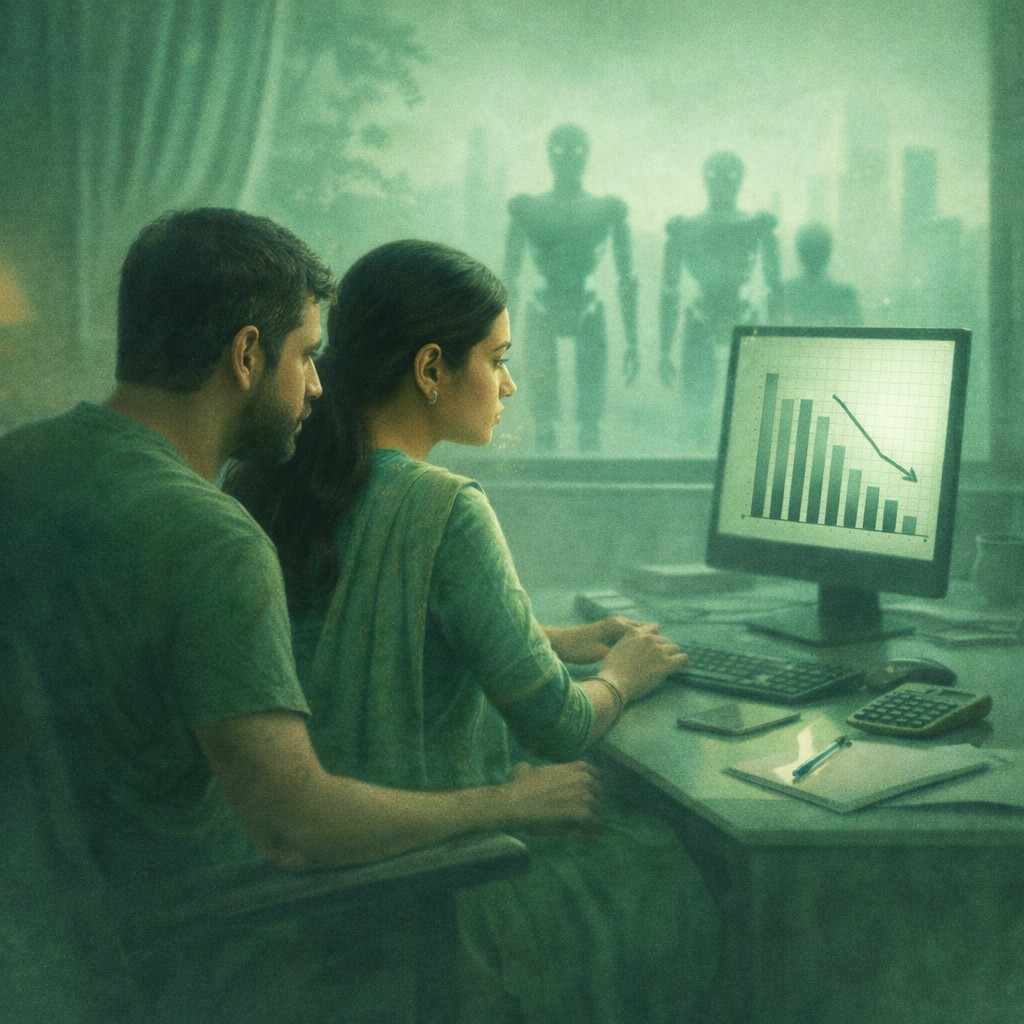
Priya noticed it first. The code reviews that used to take her team three days were now done overnight — by an AI tool their company had quietly deployed. Arjun, a data analyst two floors above her, started finding his Monday morning dashboards fully built before he even opened his laptop. Neither of them said anything to the other for a few weeks. They just noticed. And in that silence, something uncomfortable was taking shape.
They did what most educated, well-earning Indians do when they sense trouble but cannot name it — they googled, scrolled LinkedIn at midnight, forwarded articles to each other, and argued quietly over dinner about whether this AI thing was real or just another hype cycle. It was real enough. Within six months, both their departments had posted a combined headcount reduction of 22 percent. Neither Priya nor Arjun lost their job that round. But they felt, with the particular clarity that close calls give you, that they were standing at the edge of something large and fast-moving.
They decided to seek counsel rather than just consume more content. First, they went to a psychologist. Then, to a financial planner. What those two conversations gave them was not a guarantee — nothing can give you that — but something more useful: a way of thinking.
I have watched this fear move through many young professionals over the past few years — that specific dread of becoming irrelevant, not through any failure of effort, but simply because the world shifted beneath their feet. It reminds me of something I understood only after I moved to Vrindavan: that most of our anxiety about the future is not really about the future. It is about how little we trust ourselves to handle it.
The psychologist’s mirror
“You are catastrophising,” the psychologist told them in the first session, “not planning.” She was not dismissing their fear. She was making a precise distinction. Catastrophising is the mind running worst-case loops — job gone, EMIs unpaid, parents disappointed, children’s school fees uncertain — without ever converting that energy into a usable question. Planning takes the same fear and asks: so what would I actually do? It is the same raw material. One paralyses. The other moves.
“Fear is information. It is telling you to prepare. But if you only feel it and never act on its signal, you are paying the full cost without collecting any of the benefit.”
She then placed their situation inside a larger frame — the Great Depression of 1929. When Wall Street collapsed and the American economy contracted by nearly a third, two very different kinds of people lived through it side by side. The first group froze. They pulled their savings from banks in panic — ironically accelerating the very banking collapse they feared — stopped using their skills, waited for someone else to fix things, and found themselves worse off at every turn. The second group adapted quickly: they redeployed their capabilities wherever there was still need, reduced their consumption before it was forced on them, built tighter community with those around them, and — this is the part I find most remarkable — kept a sense of daily purpose even when the external world offered none.
Research on Depression-era survivors consistently shows the same result: those who believed their actions mattered fared dramatically better — mentally, financially, relationally — than those who believed the storm controlled them. The AI disruption of the 2020s is structurally similar. It will not destroy all work. But it will end the complacency of assuming your current role is permanent. The task is identical to 1929: move from passive dread to active adaptation.
“The workers who survived the Depression were not the strongest or most credentialled. They were the most psychologically honest — and the most willing to move.”
When I left the full-time hustle and chose Vrindavan, people around me worried on my behalf. “What will you do? How will you manage?” The honest answer was: I had been preparing for this choice for years without fully knowing it — building skills that were mine, building client relationships built on trust rather than commission, building a financial cushion that was not glamorous but was real. The freedom I live now was not luck. It was accumulated preparation. The time to build your runway is when you are still in the air.
What Chanakya knew about empty treasuries
The financial planner, to his credit, did not open with product brochures. He opened with Chanakya.
The Arthashastra — Chanakya’s fourth-century BCE treatise on statecraft, economics, and the art of governance — was written for rulers whose kingdoms could be swept away by drought, invasion, or a single disloyal minister. His most repeated warning was kosh-mool balam: the treasury is the root of all strength. Not the army. Not the alliances. The reserves.
And Chanakya was not speaking only of gold. He meant every stored resource that gives you options when circumstances change — skills, relationships, knowledge, grain, land, goodwill. A kingdom with no reserve must beg from its enemies the moment the harvest fails. A person with no reserve must beg from their employer the moment the quarterly results disappoint.
“The king who has no treasury cannot protect his subjects. The man who has no reserve cannot protect his family.”— Chanakya, Arthashastra (~321 BCE)
Brought into 2026: your salary is not your strength. Your employable skills, your savings, and your network of trust are your treasury. If all three are thin — if you are spending everything you earn, growing no new capability, and maintaining no relationships outside your current employer — then you are a kingdom that looks prosperous from the outside but cannot survive one bad season.
Chanakya also wrote about yoga-kshema — two movements that together define a secure life. Yoga is acquiring what you do not yet have: new skills, new income streams, new relationships. Kshema is protecting what already exists: your savings, your health, the trust of your family. Most people in crisis have been doing neither — they have been consuming their treasury and building nothing to fill it back up.
The Gita says something that has stayed with me for years: yoga-kshemam vahamyaham — I carry both your welfare and your security. It is Krishna speaking, but I have always read it as a reminder of what we owe ourselves. No one else is coming to carry it for you. The responsibility of building your treasury — your kosh — is yours alone, and it is an act of love toward everyone who depends on you.
The financial planner’s honest arithmetic
The planner’s first question was simple and a little devastating: “If both of you lost your jobs tomorrow, how many months could you survive — without borrowing, without selling any asset?”
Priya and Arjun looked at each other. Three months.
He called this the runway. Three months, he said, is a runway so short that any real turbulence ends in a crash. AI-driven displacement does not move like a traditional layoff, where you find a similar role in the same category within weeks. It moves across entire categories, and the search for the next version of yourself takes longer than most people expect when they are comfortable and employed.
His framework was not complicated. It was just honest:
Six Steps to Build Real Resilience
- ✓Build a 12-month emergency fund — not 3, not 6. Keep it in a liquid debt fund or a sweep-in FD. This is not an investment. This is your kosh. Do not invest it in equities. Do not touch it for a vacation. It exists for one purpose only: to buy you time when time is the only thing that matters.
- ✓Eliminate lifestyle debt before it eliminates your choices. Depression-era families with heavy consumer borrowing were wiped out within months of the crash. In today’s terms: prepay high-interest personal loans, stop accumulating credit card revolving debt, and question every EMI on something that loses value the moment you buy it.
- ✓Do not pause your SIP — but give it a real destination. Long-term equity SIPs remain one of the most accessible wealth-building tools for the Indian salaried class. Keep them running. But a SIP without a goal is just a habit. Know what you are building toward — children’s education, your own early freedom, a second home. Goals turn savings into intention.
- ✓Build a second income stream before you need one. This is Chanakya’s yoga in financial form. Freelancing, consulting, teaching, content creation, rental income — the source matters less than the discipline of starting. Even ₹8,000–10,000 a month from a source independent of your employer changes your inner posture from dependency to choice.
- ✓Run a human capital SIP alongside your financial one. Set a fixed monthly amount for learning — AI tools, certifications, domain expertise, communication, writing. Skills compound quietly, and unlike money in a market, they cannot be taken from you in a restructuring announcement.
- ✓Invest in your relationships the way you invest in your portfolio. The families that rebuilt fastest after 1929 were embedded in functioning communities — colleagues, mentors, neighbours who trusted them. Your network is a financial asset. Maintain it long before you need to draw on it.
What is the rightful way to live?
Near the end of their sessions, the psychologist asked something neither Priya nor Arjun had been expecting: “If your IT salaries disappeared tomorrow — and you were genuinely not allowed to feel like a failure about it — what would your life look like?”
There was a long pause. Priya said she would probably teach. Arjun said he had always wanted to work with data for a cause he actually believed in.
This is the question the Bhagavad Gita has been asking for three thousand years. Krishna tells Arjuna — a different Arjuna, paralysed on a different battlefield — that it is better to walk your own svadharma imperfectly than to walk someone else’s path with great skill. Your rightful way of living is not the highest-earning way, not the most prestigious way, but the way that is genuinely, specifically, irreplaceably yours.
AI will become extraordinarily good at doing what most people are doing — following templates, executing patterns, producing the average of everything that has come before. What it cannot replicate is the particular way you see a problem, the specific trust you have built with specific people over years, the wisdom that only comes from having lived your particular life. That is not sentiment. That is competitive advantage.
“The deepest financial resilience and the deepest personal resilience are the same thing: knowing who you are when the job title is removed.”
Vrindavan taught me this slowly, the way all real things are taught. When you simplify your life — when you stop needing the salary to tell you who you are — you stop being afraid of losing it. That is not indifference to money. I still earn. I still advise clients carefully, the same way I always have, on fee and not commission, because my integrity is the only thing I actually own. But the fear is gone. And the fear, I have come to believe, was always the real poverty.
What Priya and Arjun did next
They came home from their appointments and wrote three numbers on a piece of paper: current runway (3 months), target runway (12 months), gap (approximately ₹9 lakhs). Then they sat with their monthly expenses and found ₹18,000 they could redirect without any genuine hardship — habits mistaken for needs, subscriptions running silently in the background, upgrade impulses dressed up as necessities.
At that rate, the gap closes in four years. Faster if either of them builds any supplementary income.
Arjun enrolled in a part-time AI-assisted analytics course — not to race the machine, but to learn how to direct it. That distinction is everything. Priya began taking freelance UX projects on weekends — earning modestly for now, but building a portfolio and a client list that are entirely hers, that exist independently of any employer’s decision-making.
They are not fearless. But they have converted fear into motion. And as Chanakya observed, the king who prepares in peacetime does not beg in wartime.
I think of them — and of the many couples like them — every time I sit for morning prayers here in Vrindavan. The bhakti tradition says something simple that I return to often: the purpose of life is not to accumulate, but to be steady. Steady in action. Steady in faith. Steady in who you are when the world keeps changing around you. That steadiness is built — slowly, deliberately, one honest choice at a time. It is available to all of us. It just requires that we begin.
· · ·
About the author: Sumit Bhandari lives in Vrindavan and has been a fee-based health insurance advisor since 2009 — one of India’s first commission-free consultancies. He writes about mindful living, honest money, and the examined life at happinessispossible.com. The financial principles in this article are general in nature and not personalised advice. For your specific situation, consult a SEBI-registered fee-only financial planner.