The Controlling Saas — Every Demand Has Fear Underneath It A compassionate, honest guide for the saas who controls — and for every bahu who lives with her. Because underneath every sharp instruction, every watchful eye, every demand that things be done her way — there is almost always a woman who is simply, profoundly …
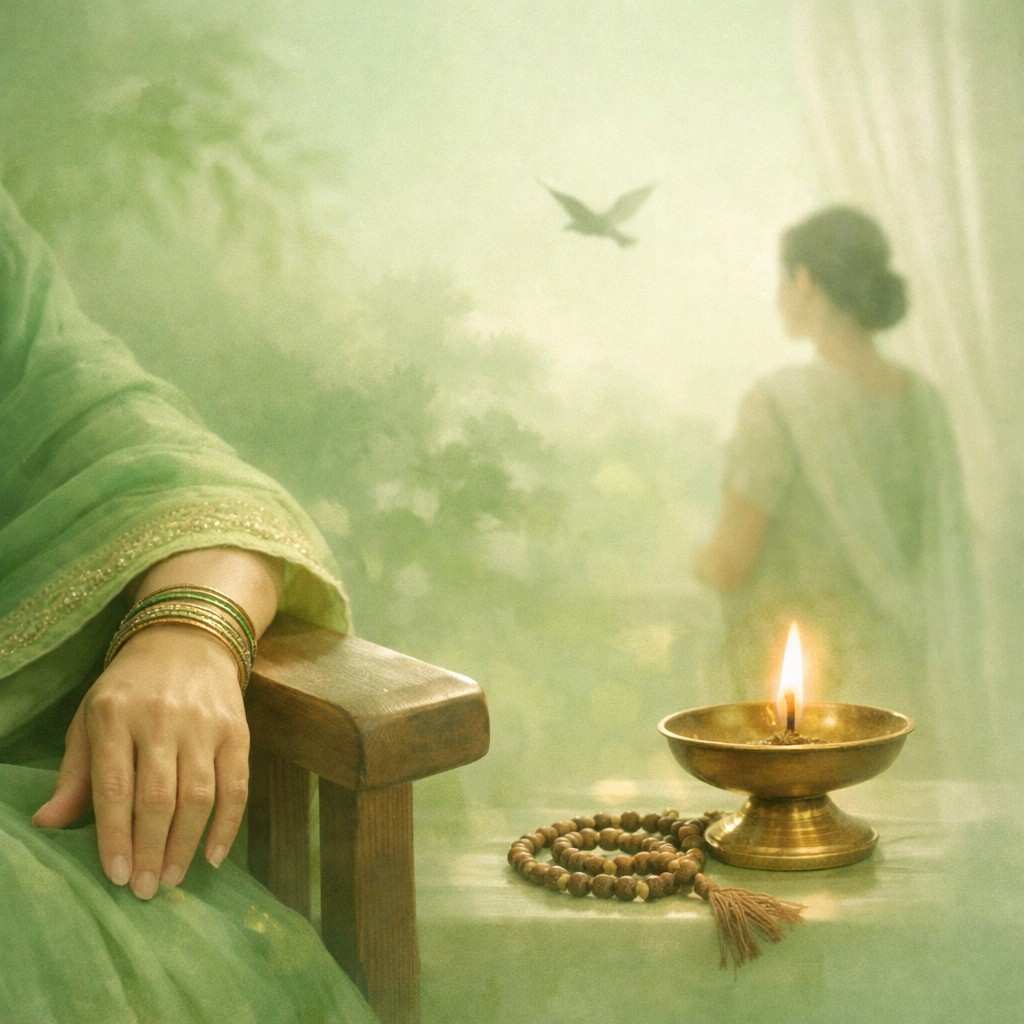

The Controlling Saas — Every Demand Has Fear Underneath It
A compassionate, honest guide for the saas who controls — and for every bahu who lives with her. Because underneath every sharp instruction, every watchful eye, every demand that things be done her way — there is almost always a woman who is simply, profoundly afraid.
Nobody called Sulochana controlling to her face. They were too careful for that. But in the kitchen whispers, in the phone calls her bahu Neha made to her mother every Sunday morning with the bedroom door closed, in the way her son Rahul’s shoulders tensed the moment he entered the house — the word was there, unspoken, filling every room.
Sulochana had opinions about everything. The dal needed more jeera. The children’s school project should be done differently. The weekend plans were inadvisable. The bahu’s family visited too frequently. The household budget was being managed incorrectly. The grandchildren were being raised too loosely. The curtains in the drawing room were the wrong colour.
She delivered these opinions not as suggestions but as corrections — with the authority of someone who had managed this household for twenty-two years before Neha arrived, and who saw no reason why correct standards should be abandoned simply because a new woman had entered the picture.
Neha had tried, in the early years, to understand. She had tried patience, compliance, careful navigation. She had tried asking Rahul to speak to his mother. She had tried speaking to Sulochana directly. Nothing had worked. The corrections continued. The atmosphere thickened. And the marriage — which had begun with genuine warmth — had developed a particular quality of strain that both Rahul and Neha had stopped discussing because discussing it always led to the same place: nowhere.
What nobody in this house had yet done was ask the question that changes everything.
Not: why does she control? But: what is she afraid of?
01 — Recognise the Problem: Control Is Not a Personality. It Is a Response.
Bhaya — fear, the root of most harmful behaviour
The controlling saas is one of the most recognisable figures in Indian family life. She appears in films, in jokes, in the complaints of a million bahus. She is usually portrayed as a villain — the obstacle, the antagonist, the source of the problem. This portrayal is understandable. It is also incomplete.
Control, in the Vedic understanding, is not a character flaw that some people are born with. It is a fear response. It is what happens when a person’s sense of safety becomes dependent on their ability to manage the environment around them. The more unsafe they feel internally, the more they attempt to regulate externally. The controlling saas is not a powerful woman. She is a frightened one who has learned that control feels safer than vulnerability.
“Every demand she makes is a sentence she cannot finish. The full sentence is: I need things to be this way because I am afraid of what happens if they are not.”
What is Sulochana afraid of? If you sat with her — really sat with her, past the corrections and the authority and the opinions — the fears would eventually emerge. They almost always do, for women like her, when someone is patient enough to find them:
- She is afraid of becoming irrelevant — of the day when the household no longer needs her knowledge, her standards, her presence
- She is afraid of losing her son — not to death, but to a life so separate from hers that she becomes a visitor in it
- She is afraid that if she loosens her grip, things will fall apart — because for twenty-two years, her grip was what held things together
- She is afraid of ageing — of the slow narrowing of her world, of dependence, of invisibility
- She is afraid, underneath everything, that she is not loved for herself — only for her usefulness. That the moment she stops being useful she will be set aside
These fears are not irrational. They are the fears of a woman navigating a genuine transition — from the centre of the family to its periphery — without any map, without anyone having prepared her for it, and without the inner resources that would allow her to make the transition with grace rather than with resistance.
The control is the symptom. The fear is the disease. And the family that treats only the symptom — by enduring it, or fighting it, or avoiding it — will never reach the root.
02 — The Vedic Answer: Abhinivesha — The Fear of Losing What We Have
The fifth klesha — the deepest, most universal human fear
Patanjali’s Yoga Sutras identify five kleshas — five root causes of human suffering. The fifth, and in many ways the most powerful, is abhinivesha: the fear of loss, the clinging to what is, the terror of change and endings. Patanjali says, with remarkable precision, that this klesha afflicts even the wise. It is not a failing of the weak or the unspiritual. It is the most fundamental expression of the ego’s terror of its own impermanence.
“Svarasavahi vidushah api tatha rudhah abhiniveshah.”
Patanjali Yoga Sutras, 2.9 — The fear of death and loss flows by its own momentum and is deeply rooted even in the wise.
Sulochana’s control is abhinivesha in domestic form. She is clinging — to her role, to her relevance, to the particular arrangement of life that has given her a sense of security and purpose for two decades. The clinging expresses itself as control because control is the ego’s attempt to prevent the loss it fears. If I manage everything, nothing can be taken from me. If I maintain the standards, I remain necessary. If I correct every deviation, the old order survives.
But the old order cannot survive. It was always going to change. The son was always going to grow, marry, build his own family. The daughter-in-law was always going to bring her own ways. The household was always going to reorganise. Sulochana’s control is not preventing this — it is only ensuring that the transition is painful for everyone, including herself.
The Vedic remedy for abhinivesha is not willpower or discipline. It is the cultivation of a deeper security — one that does not depend on external arrangements remaining intact. It is the discovery, through spiritual practice, that the self has a foundation that no change can destroy.
03 — The Law of Karma: What Control Produces Is the Opposite of What It Seeks
Karma — the precise law of cause and effect in human relationships
The law of karma operates with particular clarity in close relationships. What Sulochana wanted from her control was connection — to remain central, to remain needed, to remain loved in the active, daily way a mother is loved when her children are young and dependent. What her control was producing was the opposite: distance. Resentment. A son whose shoulders tensed at the door. A bahu who called her mother with the bedroom door closed. Grandchildren who sensed the tension without understanding it.
This is the terrible irony of the controlling saas’s karma. The tighter she holds, the more she loses. Every correction that drives her bahu away is a vote against the very closeness Sulochana craves. Every manufactured crisis that pulls her son back temporarily pushes him a little further emotionally. The control that feels like self-preservation is generating exactly the abandonment it fears.
“She held so tightly because she was afraid of losing them. She did not yet understand that the holding was the losing — one clenched fist at a time.”
The karma of release is different. The saas who loosens her grip — who trusts the bahu with the kitchen, who lets the son make his own decisions, who offers opinion only when asked — generates a different quality of relationship. Not distance. The particular warmth of people who feel trusted. Who return not because they must, but because they want to. Because the house feels like a place where they are welcomed rather than managed.
04 — The Law of Destiny: Security Was Never in the Arrangement
Prarabdha — the arc of a life that includes this transition, by design
Sulochana had built her security, her entire adult life, in an external arrangement — the household, the role, the particular structure of a family that needed her at its centre. This was not a mistake. For the Grihastha stage of life, it was entirely appropriate. The householder’s dharma is exactly this: to build, to manage, to maintain, to be the active centre of a family’s functioning.
But the Vedic tradition is explicit: this stage ends. It was designed to end. The prarabdha of every householder includes this transition — from the active centre to the wise periphery, from the manager to the elder, from the architect to the ancestor. The tradition does not present this as a loss. It presents it as a graduation.
Sulochana had not been told this. Or she had been told it in ways that did not reach her — in temple discourses she heard with half her attention, in scriptural readings that seemed abstract until they were suddenly, uncomfortably personal. Nobody had sat with her and said: this transition you are resisting is actually the next stage of your dharma. The universe is not punishing you by making you less central. It is promoting you — to something quieter, deeper, and ultimately more meaningful, if you can stop fighting it long enough to receive it.
“The control was her way of refusing a promotion. The universe kept offering it. She kept sending it back.”
Low-worry attitude, for Sulochana, begins with this recognition: the new arrangement is not a threat to her security. It is an invitation to build her security on something more permanent than any domestic arrangement has ever been — on the self, on the spirit, on the accumulated wisdom of a life fully lived.
05 — The Conversation That Has to Happen — With Herself
Svadhyaya — self-study, the most uncomfortable and most necessary practice
Before Sulochana can have any productive conversation with her son or her bahu, she must have a conversation with herself. An honest one. The kind that requires sitting quietly — in the puja room, or on the terrace before the house wakes, or in any private space where the performance of being in control can be briefly set down — and asking:
What am I actually afraid of?
Not what is wrong with the dal, or the school project, or the bahu’s family visiting too often. Those are the surface. Underneath the surface: what is the fear? Name it. All of it. Without the defences that make it presentable.
This conversation is extraordinarily difficult for a woman who has organised her entire life around competence and management. Admitting fear feels like admitting weakness. Admitting vulnerability feels like surrendering the only ground she stands on. But the Yoga Sutras are clear: svadhyaya — honest self-study — is not optional for those who wish to be free of the kleshas that bind them. The fear examined loses most of its power. The fear unexamined runs everything.
- Set aside ten minutes each morning — before the household wakes — to sit with the question: what am I controlling today, and what am I afraid of underneath it?
- Write the answers. Not to share — to see. The act of writing makes the fear visible, and what is visible can be worked with
- Find a spiritual teacher, a satsang, a trusted elder — someone outside the family with whom the real fears can be spoken without consequence
- For each controlling behaviour, ask honestly: what am I trying to prevent? Is the prevention working? What is it costing?
06 — For the Bahu: Compassion Without Compliance
Karuna — compassion that sees the person behind the behaviour
This post is written primarily for the saas. But the bahu reading it deserves a direct word too.
Understanding that the control comes from fear does not mean you must accept unlimited control. Compassion and compliance are not the same thing. You can see clearly that your saas is frightened without agreeing to be managed by her fear indefinitely. You can hold both truths simultaneously: she is doing this from a place of pain, and it is not acceptable for it to continue unchecked.
The most useful thing you can do — more useful than endurance, more useful than confrontation — is to stop treating her as an adversary and start treating her as a frightened elder who has not yet found her footing in this new chapter. This is not a technique for managing her. It is a genuine shift in perception that changes the quality of every interaction.
Ask her, sometimes, about her life before you arrived. About the years that made her who she is. About what she was like as a young woman, as a young bahu herself. The answer to that last question is almost always illuminating — because the controlling saas was almost always, at some point, a bahu who was controlled. She learned what she lived. She is doing what was done to her, because nobody showed her another way.
“She is not your enemy. She is your future, if you are not careful — the woman you might become if nobody helps you find a better way through the same transition. Have compassion. And also, set your boundaries. Both.”
07 — Skills to Build: The Three-Year Journey From Control to Trust
Abhyasa — the patient practice of replacing a fear habit with a trust habit
Year One — Identify and Interrupt
The controlling habit is so deeply embedded that Sulochana often does not notice it until the correction has already left her mouth. Year One is about developing the awareness to catch it — not always before it happens, but increasingly often. The gap between impulse and action is where change lives. Even a half-second pause — enough to ask, is this necessary, is this kind, is this the relationship I want? — begins to create a different pattern over time.
- Choose one area of household management to consciously hand over — completely, without supervision or correction. The kitchen, the children’s schedule, the weekend plans. One thing, fully released.
- When the urge to correct arises, pause and ask: will this matter in five years? If no — let it go
- Begin a spiritual practice that is entirely about receiving rather than doing — a meditation, a devotional practice, a form of prayer that asks nothing of the household
- Count, privately, how many corrections you withhold in a day. Each one is a small act of trust. Celebrate them.
Year Two — Build the Inner Security That Makes Control Unnecessary
Control is a substitute for inner security. The work of Year Two is to build the real thing — through spiritual practice, through community, through the cultivation of an identity and a sense of purpose that exists independently of the household’s need for her management. When the inner security grows, the need to control the outer environment naturally diminishes. Not through willpower. Through genuine sufficiency.
- Join or deepen a satsang, a seva practice, a spiritual community — something that gives her a role and a significance that has nothing to do with the domestic hierarchy
- Study the Bhagavad Gita’s teaching on non-attachment — not as philosophy but as practical daily guidance for releasing the grip
- Practise asking rather than telling — “What do you think?” before “This is what should be done”
- Notice what happens in the family when she releases control in one area — usually, things work out. Let that evidence accumulate.
Year Three — Become the Wise Elder, Not the Anxious Manager
The elder’s authority in the Vedic tradition is not based on control. It is based on wisdom — on the accumulated understanding of a life fully lived, offered freely to those who seek it, withheld gracefully from those who do not. Year Three is about making this transition consciously — from the woman who manages to the woman who knows. From the one whose authority depends on compliance to the one whose authority is sought willingly, because it has been earned and offered without coercion.
- Offer advice only when asked — and when asked, give it fully and without attachment to whether it is followed
- Share your experience as story rather than instruction — “When I was raising Rahul, I found…” rather than “You should…”
- Celebrate your bahu’s successes in the household genuinely — her competence is not your diminishment
- Build the kind of relationship with your grandchildren that only a wise, unhurried elder can build — not through management, but through presence, stories, and the unhurried gift of your full attention
“The saas who releases control does not become less important. She becomes important in a way that nobody can take from her — because it is no longer stored in an arrangement. It is stored in who she is.”
The Final Word
Sulochana did not change overnight. Change of this kind never happens overnight. It happens in small moments, accumulated over months — the correction withheld, the opinion kept private, the bahu’s decision allowed to stand even when it was not the decision Sulochana would have made.
Six months into her effort, Neha came to her — unprompted, without agenda — and asked her how she made the particular pickle that Rahul loved. Not because Neha needed the recipe. Because she had noticed something shifting in the house, and she wanted to meet it halfway.
They spent an afternoon making pickle together. Sulochana taught. Neha learned. Nobody corrected anyone. The kitchen, for that afternoon, was simply a place where two women who loved the same man were finding their way to each other — slowly, imperfectly, in the language of jeera and raw mango and the particular patience that preservation requires.
It was a small thing. It was also the beginning of something neither of them had words for yet.
The fear had not disappeared. But for one afternoon, it had been quiet enough that something better could grow in its place.
Tags: Vedic Living · Saas · Control · Fear · Bahu · Family · Patanjali · Karma · Transformation · Relationships