“Peace is not found by running away from life… it is built by facing it.” Rahul was like many of us. A 30-year-old middle-class Indian man, working in a decent job, carrying silent pressure on his shoulders. On paper, his life looked stable. But inside, it was a different story. Every day after work, he …

“Peace is not found by running away from life… it is built by facing it.”
Rahul was like many of us.
A 30-year-old middle-class Indian man, working in a decent job, carrying silent pressure on his shoulders. On paper, his life looked stable. But inside, it was a different story.
Every day after work, he would sit quietly in his room and think—
“Is this really my life?”
“Am I just going to do this job forever?”
“What about peace… what about purpose?”
At home, there were expectations.
“Beta, now it’s time to get married.”
“Think about your future, settle down.”
At work, there were deadlines.
“Targets need to be met.”
“Performance reviews are coming.”
And within him, there was a storm.
The Trap of Overthinking
Rahul had developed a habit—overthinking everything.
Every decision felt heavy.
Every situation felt confusing.
At night, he would scroll endlessly through Instagram and YouTube.
And slowly, his algorithm started feeding him a different world.
Videos of spiritual life.
Stories of people who left everything behind.
Peaceful visuals of temples, bhajans, saints, and a slow, calm life in Vrindavan.
The message was subtle but powerful:
“Leave everything… find God.”
“True happiness is not in jobs, but in devotion.”
“Vrindavan is not a place, it’s a calling.”
Rahul started believing it.
The Emotional Decision
One day, overwhelmed by thoughts and inspired by what he saw online, Rahul made a bold decision.
He quit his job.
Just like that.
He told his parents—
“I’m going to Vrindavan… I want to dedicate my life to spirituality.”
They were shocked.
His friends tried to stop him—
“Think practically.”
“Don’t rush.”
But Rahul wasn’t thinking anymore.
He was feeling.
And emotions, when not balanced with wisdom, can be dangerous.
The Initial Illusion
When Rahul reached Vrindavan, everything felt magical.
Temple bells echoed in the air.
Devotional songs played everywhere.
People seemed peaceful and detached.
For the first few days, he felt—
“This is it. This is what I was missing.”
But slowly, reality began to reveal itself.
Exploitation in the Name of “Seva”
Rahul met a few men who introduced themselves as volunteers from an ashram.
They spoke kindly.
“You are educated. We need people like you here.”
“You can serve here… and in return, you’ll get food and a place to stay.”
It sounded perfect.
Rahul agreed.
But within weeks, things changed.
- He was made to work 10–12 hours a day
- No clear role—just instructions and orders
- No financial support at all
- Even basic respect was missing
Whenever Rahul tried to question—
“Can I earn something? I need basic money…”
The response was immediate:
“Are you here for service or money?”
He felt guilty for even asking.
But deep inside, something didn’t feel right.
This wasn’t devotion.
This was dependency.
This wasn’t service.
This was exploitation.
The Ashram Plot Scam
Just when Rahul was trying to adjust, another “opportunity” came his way.
A group of people approached him with a proposal.
“There is land available near an ashram.”
“It is very cheap right now.”
“In the future, it will become very valuable.”
But the real hook was emotional:
“This is sacred land.”
“Living here will bring spiritual growth.”
“This is God’s blessing.”
Rahul, already emotionally vulnerable, believed them.
He invested a large portion of his savings.
Days later, reality hit him hard.
- The documents were incomplete
- Ownership was disputed
- The people who sold it disappeared
Rahul was cheated.
The Breaking Point
Now he had:
- No job
- Almost no money
- No stability
- No clarity
He sat on the steps of a temple one evening, staring into nothing.
For the first time, he asked himself honestly—
“Did I come here to find God… or to escape my life?”
That question shook him.
Because deep down, he knew the answer.
He wasn’t searching.
He was escaping.
Meeting the Right Guru
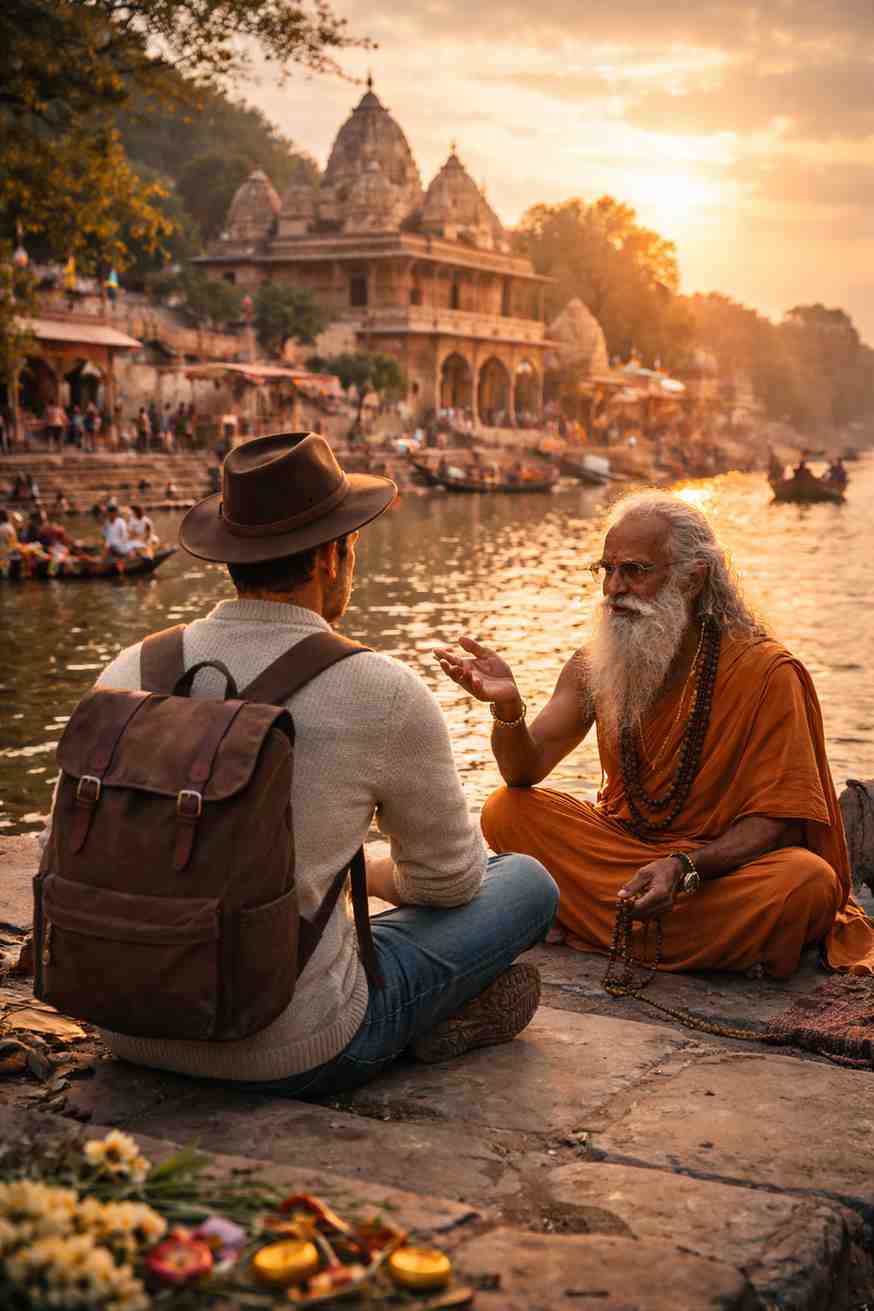
In this state of confusion, Rahul met someone who changed his life.
A simple-looking guru.
No fancy setup.
No big claims.
But his words carried weight.
Interestingly, he had once worked in the corporate world in Mumbai.
He understood both worlds—material and spiritual.
After listening to Rahul’s story, he said something Rahul would never forget:
“You don’t need devotion right now… you need clarity.”
Rahul was silent.
Lessons That Changed Everything
The guru didn’t give him emotional comfort.
He gave him truth.
1. “Escaping is not spirituality.”
“If you are running away from responsibilities,
you are not spiritual… you are avoiding reality.”
2. “Real tapasya is in responsibility.”
“Going to office daily, handling pressure,
taking care of family, and still staying calm—
that is real discipline.”
3. “Skill building is also spiritual growth.”
“Improving yourself… learning new skills…
earning better… becoming independent—
this is also a form of growth.”
4. “Don’t be emotionally foolish.”
“Not every sweet talk is truth.
Not every spiritual place is pure.
Not everyone wearing white is a saint.”
5. “Come back when you are stable.”
“First become financially and mentally strong.
Then, if you still feel the call… come.”
The Return — A New Beginning
This time, Rahul didn’t argue.
He didn’t resist.
He accepted.
He returned to his city.
But he was no longer the same person.
Rebuilding Life — The Right Way
Rahul started again.
But now with awareness.
1. He Focused on Learning New Skills
He realized that growth is not just spiritual—it is practical too.
He started learning:
- Digital skills
- Communication
- Financial literacy
- Problem-solving
He understood—
“Being capable is also a form of strength.”
2. He Built Mental Toughness
Instead of running away from stress, he trained himself to handle it.
- Daily exercise
- Meditation
- Journaling his thoughts
- Reducing overthinking
He learned to sit with discomfort instead of escaping it.
3. He Took Responsibility Seriously
Earlier, he saw family expectations as pressure.
Now he saw them as duty.
There was a shift.
From burden → to purpose.
4. He Practiced Balanced Spirituality
He didn’t leave spirituality.
He matured it.
- 15–20 minutes of daily meditation
- Gratitude practice
- Staying connected with inner peace
But without abandoning real life.
The Biggest Realization
Rahul finally understood something powerful:
“Vrindavan is not just a place… it is a state of mind.”
If your mind is restless,
you will be disturbed even in a temple.
If your mind is calm,
you will find peace even in chaos.
A Message for Every Middle-Class Indian
Many of us feel like Rahul at some point.
Tired.
Confused.
Emotionally overwhelmed.
We think—
“I should leave everything.”
“I just want peace.”
“I want a different life.”
But pause and ask—
Are you seeking peace… or escaping pressure?
Hard Truths You Need to Accept
1. Social media shows edited reality
Spiritual videos often show only the good side.
Not the struggles.
Not the survival challenges.
2. Financial stability matters
Money is not everything.
But lack of money can destroy peace.
3. Responsibility is not a burden
It is your training ground.
4. Growth requires effort, not escape
Running away delays growth.
Facing life builds it.
Practical Steps You Can Take Today
1. Delay emotional decisions
Wait at least 30 days before making any big life decision.
2. Build a financial safety net
Have at least 6 months of expenses saved.
3. Invest in skills
Every 6 months, learn something new.
4. Create a daily spiritual routine
Without leaving your responsibilities.
5. Seek guidance, not validation
Find mentors who challenge you, not just comfort you.
Final Words
Life will always be difficult.
There will always be pressure.
There will always be confusion.
But the answer is not escape.
The answer is growth.
Don’t run away to find peace.
Build yourself strong enough to create it.
And remember—
“The strongest person is not the one who leaves everything…
but the one who stays, struggles, grows, and still finds peace within.”