Rohit and Neha were the kind of couple that looked perfect from the outside. Their social media was filled with smiling pictures, café check-ins, weekend trips, and captions about “living the moment.” Friends often commented, “Couple goals,” and slowly, even they had started believing it. But beneath the curated images, life had become quietly exhausting. …

Rohit and Neha were the kind of couple that looked perfect from the outside. Their social media was filled with smiling pictures, café check-ins, weekend trips, and captions about “living the moment.” Friends often commented, “Couple goals,” and slowly, even they had started believing it. But beneath the curated images, life had become quietly exhausting. Rohit worked in a corporate job where emails had no timing, and Neha ran an online business that never really switched off. Their conversations had reduced to coordination and complaints, and sometimes, small issues turned into unnecessary arguments.
One evening, as the news played in the background, something felt heavier than usual. The headlines spoke about the ongoing 2026 Iran war—missile strikes, rising global tension, troop deployments, and uncertainty spreading across countries. Reports suggested that the conflict had escalated after major airstrikes and retaliation, pulling multiple nations into its impact zone. (Wikipedia)
Rohit muted the TV and said, “Every few years, something big happens. First COVID… now this. Feels like life never stabilizes.”
Neha replied half-jokingly, “And still we’re stressed about replies and reels.”
That night, after another small argument, Rohit said, “Let’s just go somewhere. I’m tired.” Neha instinctively said Goa, but reality intervened in the form of budget constraints. After scrolling for a while, they booked tickets to Vrindavan, not out of devotion but because it was simple, available, and affordable.
When they arrived, Vrindavan felt overwhelming at first. The narrow lanes, temple bells, monkeys jumping across rooftops, and constant movement created chaos. Neha remarked that this was nothing like a peaceful vacation, and Rohit added that at least it matched their budget. But as they walked deeper into the town, something subtle changed. Beneath the visible noise, there was a strange calm, as if everything was exactly where it needed to be.
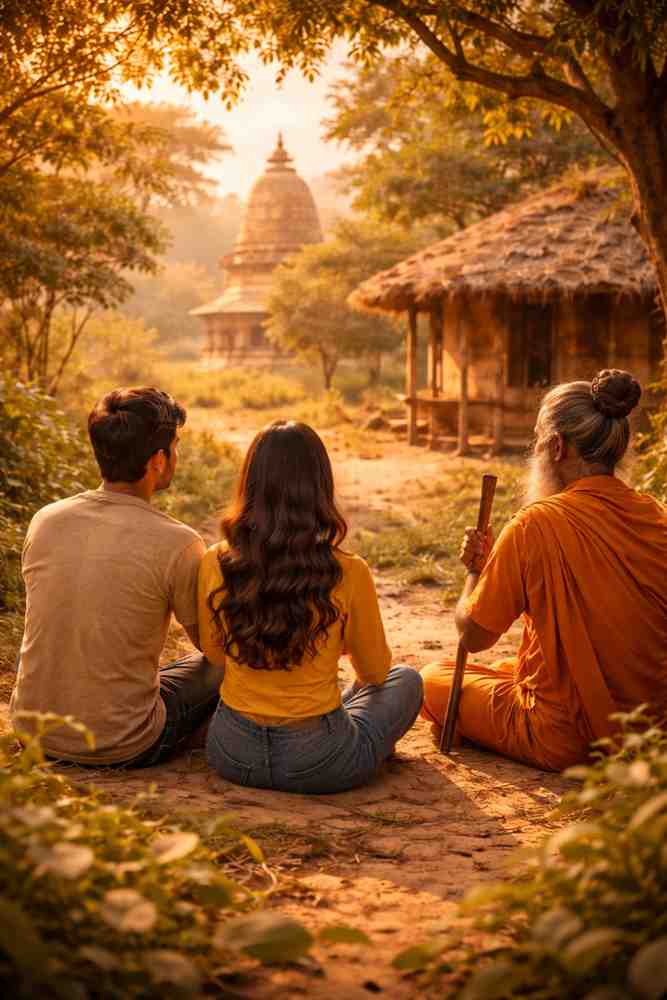
In a quieter corner, away from the crowd, they noticed a sadhu sitting under a tree. He looked completely still, detached from urgency, as if time moved differently around him. Rohit joked that the man had no boss, no EMI, and therefore no stress. Neha laughed and said this could become content if Rohit ever decided to quit his job. The sadhu looked at them and said, “You both look tired.” The words felt unusually precise.
They sat down near him, initially out of curiosity. The sadhu asked them when they had last had tea without looking at their phones. Neither could answer. He smiled and said the real problem was not technology but the constant noise in the mind.
He picked up a small stone and gave it to Rohit. “Hold this,” he said. Rohit did. Then the sadhu continued, “Now imagine I give you ten more, then fifty, then a hundred.” Rohit smiled and said his hand would give up. The sadhu nodded and explained that this is what modern life has become—people keep adding more responsibilities, possessions, and expectations, and then wonder why they feel burdened.
Neha listened quietly. It sounded too familiar.
The sadhu then quoted from the Bhagavad Gita and explained that the person who is content is truly wealthy. Rohit tried to lighten the moment with humor, questioning whether that made the richest people poor, but the sadhu calmly replied that anyone constantly wanting more is still part of the same race, regardless of how much they already have.
Then he shifted the conversation to something deeper. He asked them what they had learned during the COVID-19 Pandemic. Neha said that family had become important again, and Rohit added that health suddenly felt more valuable than anything else. They both admitted that life had become simpler and, in some ways, more peaceful.
The sadhu listened and then asked, “If you learned all this, why did you go back to the same life?”
Neither of them had an answer.
He pointed toward the world beyond Vrindavan and said, “Right now, again, the world is going through tension. Wars, uncertainty, rising costs. People are worried about the future.” This wasn’t abstract anymore. The ongoing conflict had already started affecting economies globally, increasing fuel prices and daily expenses, forcing families to cut back on essentials and rethink their lifestyles. (The Guardian)
The sadhu continued, “But these events are not just problems. They are reminders. When life becomes too complicated, it corrects itself.”
Neha asked him whether the solution was to leave everything and become like him. The sadhu smiled and said no. He explained that minimalism is not about renouncing life but about removing unnecessary burden. It means keeping what is useful and meaningful, and letting go of what only creates pressure. Earn money, but don’t let money control your mind. Use technology, but don’t lose your awareness to it.
Rohit nodded slowly. For the first time, something felt practical rather than philosophical.
Then came a moment that made them both laugh. The sadhu asked Rohit how many shoes he owned. Rohit said around six or seven. When asked how many he actually used regularly, the answer was one. The sadhu smiled and asked what the remaining pairs were doing. The humor was simple, but the point was clear.
Then came the question that changed everything. “Are you happy?” the sadhu asked.
There was a long silence. Finally, Neha said, “We are busy.” The sadhu nodded and said that this has become the new reality—people are not happy or unhappy; they are simply occupied.
Looking up at the sky, he said, “COVID was a lesson. This war is another reminder. Life keeps giving signals, but people forget quickly.”
That evening, Rohit and Neha walked through the streets without taking pictures. They had tea without checking their phones. They talked, not about tasks or complaints, but about themselves. It wasn’t dramatic, but it felt real.
When they returned home, nothing externally had changed. The job, the business, and the responsibilities were all the same. But their approach began to shift. Rohit stopped checking emails late at night unless necessary. Neha reduced mindless scrolling. They started spending time together without screens and made small but conscious changes.
Before leaving Vrindavan, the sadhu had told them something simple: changing life does not require escaping to the mountains; it only requires letting go of what is unnecessary.
Months later, Neha posted again on social media. This time, the caption was different. It didn’t try to impress. It simply said that life now looked simpler but felt fuller.
The story of Rohit and Neha is not unique, and that is why it matters. Whether it is a pandemic or a war, the pattern remains the same—life interrupts, shakes comfort, and forces reflection. The lesson is not to fear these moments but to understand them. Happiness is not found in adding more to life, but in reducing what is not needed and rediscovering what already exists.
In the end, the truth is quiet and simple. The more unnecessary weight we carry—possessions, expectations, constant noise—the heavier life feels. And when we begin to let go, even slightly, life becomes lighter. That lightness is where happiness exists, not as something to chase, but as something to allow.